RTX 4090 PSU Requirements: How Many Watts Do You Actually Need?
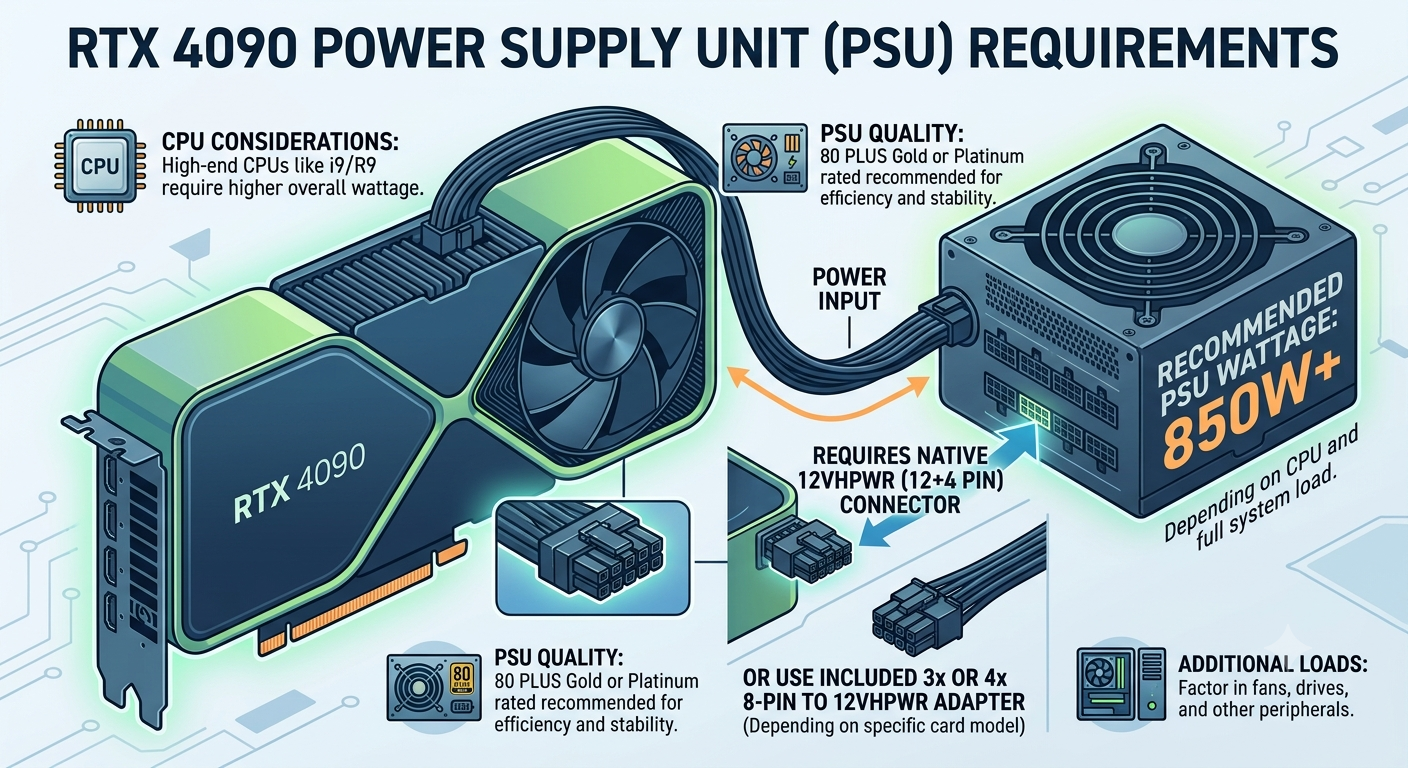
The RTX 4090 has a 450W TDP one of the highest of any consumer GPU ever made — and requires a minimum 850W PSU when paired with a low-to-mid-range CPU at stock settings. With a high-TDP CPU (i9-14900K or Ryzen 9 7950X), a 1000W PSU is the minimum and 1200W is the comfortable recommendation for any overclocking headroom. NVIDIA officially recommends an 850W PSU for the RTX 4090, but this assumes a low-TDP CPU and no overclocking most high-end 4090 builds need more.
Use the PSU calculator to get a precise wattage recommendation for your exact CPU + RTX 4090 configuration.
Why the RTX 4090 Needs More PSU Than Any Previous Consumer GPU
The RTX 4090's 450W TDP represents a significant step up from the RTX 3090 Ti (450W), RTX 3090 (350W), and even the RTX 4080 (320W). Under real gaming load, particularly in GPU-heavy titles with high power limits enabled in the NVIDIA control panel, the RTX 4090 can sustain close to its full 450W draw for extended periods.
Beyond the steady-state draw, GPU transient spikes momentary power consumption peaks that last milliseconds an briefly exceed the rated TDP by 20–30%. A PSU without adequate headroom may destabilise or shut down under these transient events even if the average draw appears within limits.
RTX 4090 PSU Requirements by CPU Pairing
| CPU | CPU TDP (PL2/Max) | System Peak Draw (est.) | Minimum PSU | Recommended PSU |
|---|---|---|---|---|
| Ryzen 5 7600X | 105W | ~590W | 750W | 850W |
| Ryzen 7 7800X3D | 120W | ~610W | 800W | 850W |
| Core i7-14700K | 253W | ~760W | 900W | 1000W |
| Core i9-14900K | 253W | ~760W | 900W | 1000W |
| Ryzen 9 7950X | 230W | ~730W | 900W | 1000W |
| Ryzen 9 7950X3D | 162W | ~660W | 850W | 1000W |
| Core i9-13900KS | 253W | ~760W | 900W | 1000W |
System peak draw includes ~75W overhead for motherboard, RAM, storage, and fans.
Confirm your exact pairing in the PSU calculator particularly for i9-class CPUs where PL2 variation and CPU cooling choices can affect sustained power draw.
- Why the RTX 4090 Needs More PSU Than Any Previous Consumer GPU
- RTX 4090 PSU Requirements by CPU Pairing
- Is a 1000W PSU Enough for an RTX 4090 Build?
- What Happens if Your PSU Is Undersized for the RTX 4090?
- The 16-Pin (12VHPWR) Connector and RTX 4090
- Do You Need to Upgrade Your PSU for an RTX 4090 Upgrade?
- PSU Brand and Quality Matter More With the RTX 4090
- Key Takeaways
Is a 1000W PSU Enough for an RTX 4090 Build?
For most stock-speed RTX 4090 builds, yes a quality 1000W unit provides sufficient headroom with any current consumer CPU at rated speeds. The exception is pairing the RTX 4090 with a very high-TDP CPU (i9-14900K or Ryzen 9 7950X) and running both at full overclock simultaneously, where a 1200W PSU becomes the safer choice.
A quality 1000W 80+ Gold PSU running at 70–80% load (700–800W actual draw) operates at peak efficiency and provides the right headroom for transient spikes this is the ideal operating zone.
What Happens if Your PSU Is Undersized for the RTX 4090?
Common symptoms of a PSU undersized for an RTX 4090 build:
- System shutdowns under GPU load particularly during GPU benchmark runs or graphically intense game scenes
- Black screen / driver crash during gaming the GPU briefly pulls more power than the PSU can deliver, causing a momentary voltage drop
- Inconsistent performance the GPU may throttle its power limit to avoid system shutdown, reducing frame rates below what the GPU is rated for
- Accelerated PSU wear consistently running near rated capacity shortens PSU lifespan
The 16-Pin (12VHPWR) Connector and RTX 4090
The RTX 4090 uses NVIDIA's 16-pin 12VHPWR connector (or 16-pin 12V-2×6 on newer cables). Key points:
- Many PSUs ship with an adapter that converts four 8-pin PCIe cables to one 16-pin connector
- Always ensure the adapter is fully seated the connector fires have been traced to incompletely seated connections, not the standard itself
- Newer PSUs include a native 16-pin cable; if your PSU is over 3 years old or lacks a native connector, verify its compatibility before pairing with an RTX 4090
Do You Need to Upgrade Your PSU for an RTX 4090 Upgrade?
If you're upgrading to an RTX 4090 from an older GPU in an existing system, check your current PSU wattage against the requirements above. Common situations:
- 750W PSU with a mid-range CPU: Undersized for the RTX 4090 upgrade required
- 850W PSU with a low-TDP CPU (Ryzen 7 7800X3D): Borderline adequate at stock, no overclock unctional but tight
- 850W PSU with a high-TDP CPU (i9-14900K): Insufficient upgrade to 1000W minimum
- 1000W PSU with any current CPU at stock: Adequate for most configurations
Use the PSU calculator with your current CPU to confirm whether your existing PSU makes the cut before buying the GPU.
PSU Brand and Quality Matter More With the RTX 4090
At 450W GPU TDP, PSU build quality becomes more critical than at lower power levels. A cheap off-brand unit rated at 850W may only reliably deliver 700W and fail to cope with the 4090's transient spikes. For an RTX 4090 build, stick to PSUs from established manufacturers with solid capacitor ratings, active PFC, and relevant safety certifications.
Key Takeaways
- The RTX 4090's 450W TDP is one of the highest of any consumer GPU sizing your PSU correctly is more critical with this card than almost any other.
- With a low-TDP CPU (Ryzen 7 7800X3D), 850W is the minimum and 1000W is recommended. With a high-TDP CPU (i9-14900K), 1000W is the minimum and 1200W adds overclocking headroom.
- NVIDIA's official 850W recommendation is conservative for most high-end CPU pairings treat it as the floor for specific low-TDP builds only.
- Always ensure the 12VHPWR (16-pin) connector is fully seated incomplete seating is a known cause of cable damage with high-power GPUs.
- If upgrading an existing system to RTX 4090, check your current PSU against your CPU's PL2 in the PSU calculator before buying the GPU.
- PSU quality matters for an RTX 4090 build, always buy from established manufacturers with solid reliability records.