Subnet Calculator
Calculate network address, broadcast, host range, and usable hosts!
Description
A subnet calculator is a digital tool that automates the process of breaking a large IP address block into smaller logical sections called subnets. Instead of manually converting IP addresses into binary and performing bitwise operations to figure out network boundaries a subnet calculator does all of that computation instantly and presents you with clear usable results. This guide covers everything from basic IP addressing to advanced CIDR planning real world deployment strategies and IPv6 subnetting for IT professionals and students alike.
What Is a Subnet Calculator
A subnet calculator is a digital tool that automates the process of breaking a large IP address block into smaller logical sections called subnets. Instead of manually converting IP addresses into binary and performing bitwise operations to figure out network boundaries a subnet calculator does all of that computation instantly and presents you with clear usable results.
At its core a subnet calculator takes two inputs from you. The first is an IP address. The second is either a subnet mask or a prefix length in CIDR notation. From those two inputs the calculator derives an enormous amount of useful information including the network address the broadcast address the range of usable host addresses the number of hosts available and the wildcard mask.
Modern subnet calculators have evolved well beyond simple tools. The best ones today support both IPv4 and IPv6 addressing allow you to plan entire network hierarchies let you specify how many subnets you need or how many hosts per subnet and automatically give you all the information needed for router configuration firewall rules and network documentation.
Think of a subnet calculator as a translator between human readable IP addresses and the underlying binary logic that routers and switches actually operate on. Networks speak in ones and zeros but people prefer decimal notation. The calculator bridges that gap instantly and accurately without leaving room for human error.
Understanding the Basics of Subnetting
Before you can fully appreciate what a subnet calculator does for you it helps to understand what subnetting actually is and why it was invented in the first place.
When the internet was being designed in the late 1970s and early 1980s the engineers who created the IP addressing system divided addresses into classes. Class A networks gave you 16 million host addresses. Class B gave you 65000 hosts. Class C gave you 254 hosts. This system was extremely wasteful. A company that needed 300 addresses had to take an entire Class B block and leave most of it unused.
Subnetting was developed as a solution to this waste. By borrowing bits from the host portion of an IP address and using them to create subnet identifiers network administrators gained the ability to divide a large address block into many smaller ones. A single Class B network could become hundreds of smaller networks each with a manageable number of hosts.
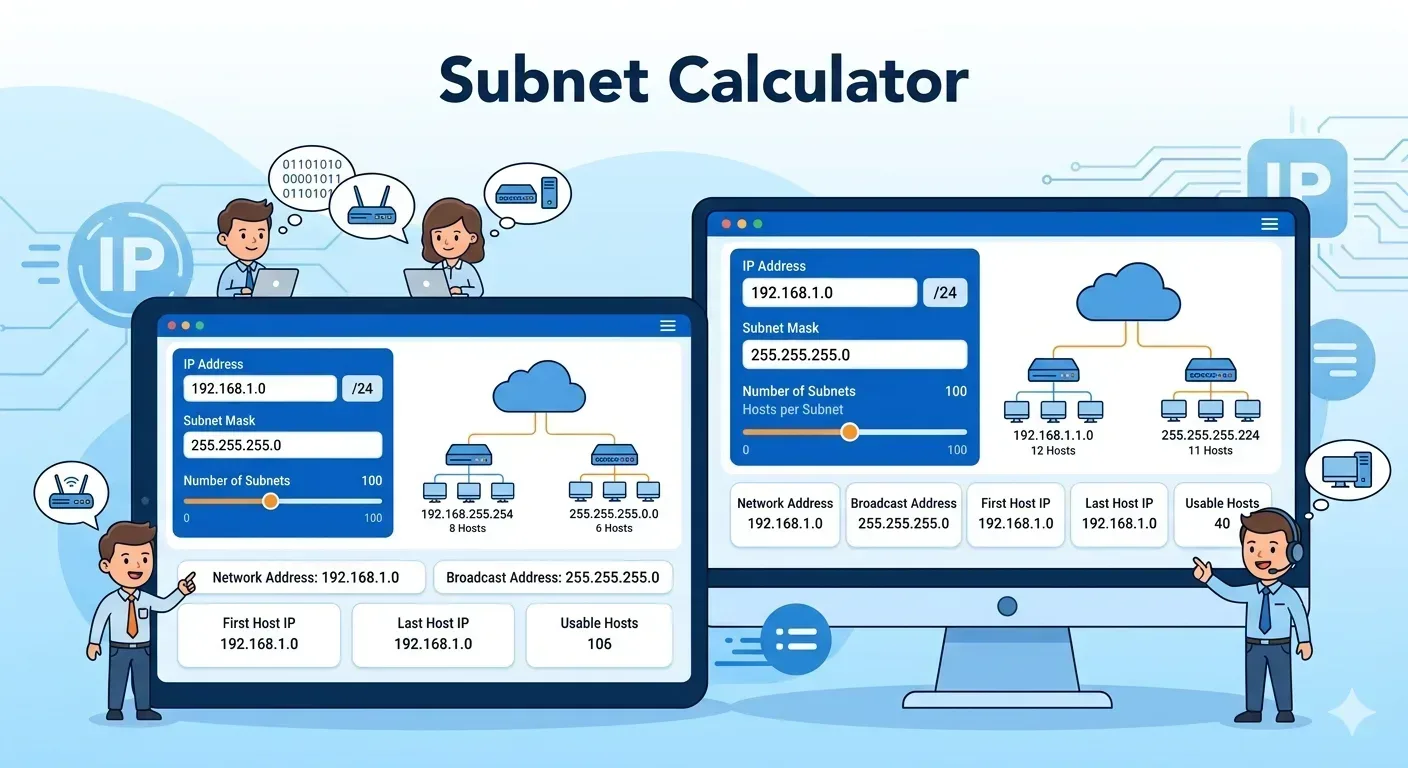
Key Terms in Subnetting
Network Address: The first address in any subnet. This address identifies the subnet itself and cannot be assigned to any device.
Broadcast Address: The last address in any subnet. Messages sent here go to every device on the subnet. Also cannot be assigned to hosts.
Usable Host Range: All addresses between the network and broadcast addresses. These are the addresses you can actually assign to computers phones and servers.
Subnet Mask: A 32 bit number that tells routers which part of an IP address identifies the network and which part identifies the host.
How CIDR Notation Works With a Subnet Calculator
CIDR stands for Classless Inter Domain Routing. It was introduced in 1993 to replace the old classful addressing system and is now the universal standard for IP address allocation. A subnet calculator that supports CIDR notation is dramatically more flexible and useful than one that works only with traditional subnet masks.
In CIDR notation the prefix length is written as a forward slash followed by a number. That number tells you how many bits in the 32 bit IP address belong to the network portion. So a prefix of /24 means 24 bits are for the network and the remaining 8 bits are for hosts. This gives you 256 total addresses with 254 usable for hosts.
CIDR Prefix Reference Table
|
CIDR Prefix |
Subnet Mask |
Total Addresses |
Usable Hosts |
|
/8 |
255.0.0.0 |
16,777,216 |
16,777,214 |
|
/16 |
255.255.0.0 |
65,536 |
65,534 |
|
/24 |
255.255.255.0 |
256 |
254 |
|
/25 |
255.255.255.128 |
128 |
126 |
|
/26 |
255.255.255.192 |
64 |
62 |
|
/27 |
255.255.255.224 |
32 |
30 |
|
/28 |
255.255.255.240 |
16 |
14 |
|
/30 |
255.255.255.252 |
4 |
2 |
One of the most powerful features of CIDR is variable length subnet masking often abbreviated as VLSM. This technique lets you use different prefix lengths for different subnets within the same network block. A subnet calculator that supports VLSM lets you allocate exactly the right size subnet for each department or function in your network rather than giving everyone the same size block.
Key Features of a Good Subnet Calculator
Not all subnet calculators are created equal. When choosing one for your work or study there are specific features that separate average tools from truly excellent ones.
IPv4 and IPv6 Support
The internet is in the middle of a long transition from IPv4 to IPv6. A professional grade subnet calculator must handle both address families fluently. IPv6 uses 128 bit addresses written in hexadecimal which makes manual calculation even more impractical than it is with IPv4.
Wildcard Mask Generation
Wildcard masks are the inverse of subnet masks. They are used extensively in access control lists on Cisco routers and in OSPF routing configurations. A quality subnet calculator automatically generates the wildcard mask alongside the subnet mask saving you from having to calculate it manually.
Subnet Splitting and Aggregation
Advanced subnet calculators let you take a larger block and automatically split it into a specified number of equal subnets. Conversely they can also perform route summarization by taking a list of subnets and finding the smallest supernet that contains all of them.
Network Overlap Detection
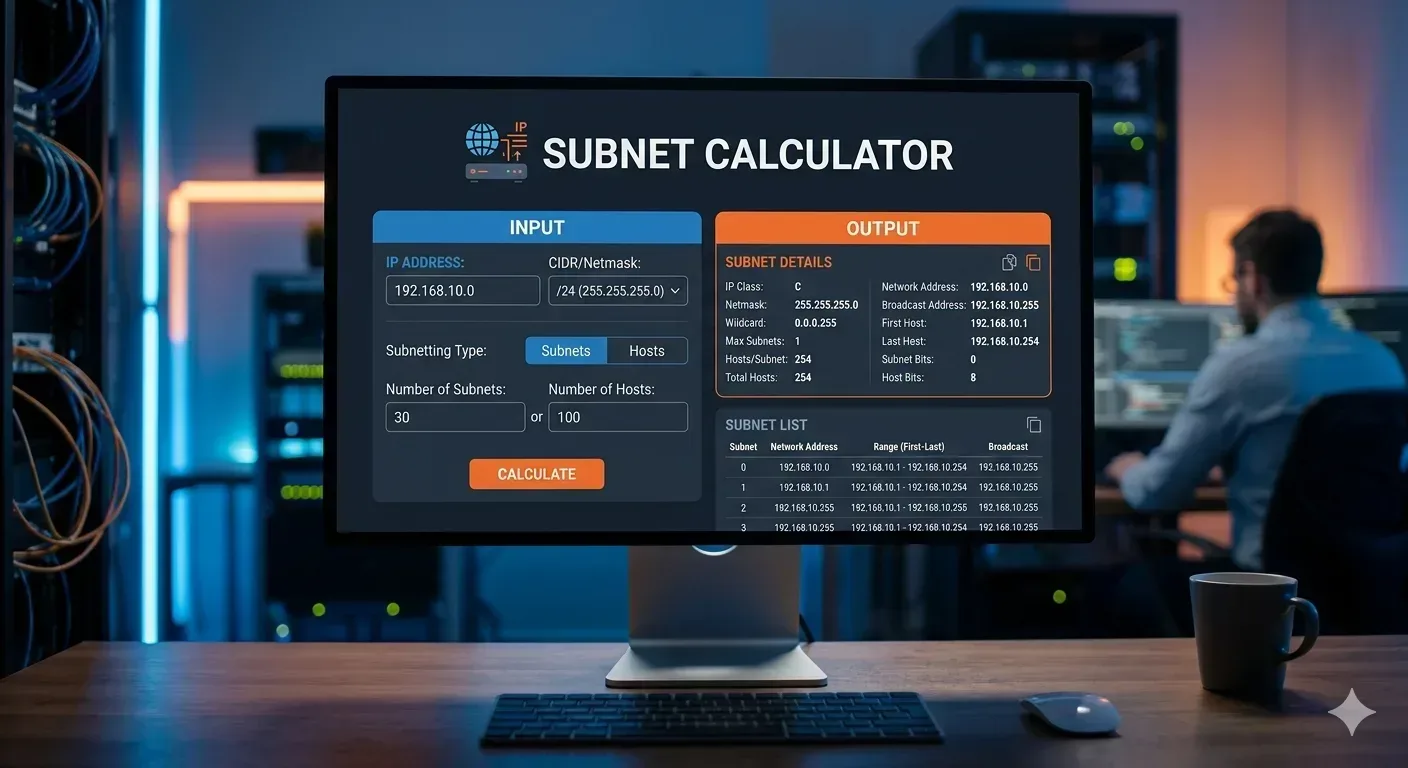
One of the most dangerous mistakes in network design is accidentally creating two subnets that overlap. When subnets overlap routers become confused about which interface to use and traffic gets dropped or routed incorrectly. A good subnet calculator warns you immediately if you are trying to create subnets that conflict with each other.
How to Use a Subnet Calculator Step by Step
Using a subnet calculator effectively requires understanding what information to put in and how to interpret what comes out. Here is a complete walkthrough of the typical process.
Determine your starting address block. This might be a block assigned to you by your ISP an RFC 1918 private address range you have chosen for internal use or an IPv6 prefix your organization has been allocated.
Identify your requirements. Before touching the calculator write down how many subnets you need and approximately how many hosts each subnet needs to support. Build in 20 to 30 percent growth room above your current needs.
Enter the network address and prefix into the calculator. Most subnet calculators accept input in CIDR format like 10.0.0.0/8 or with a separate subnet mask field.
Review the basic output. The calculator will show you the network address broadcast address usable host range number of available hosts and the wildcard mask.
Use the subdivision feature if available. If you need to break this network into smaller subnets enter how many subnets you need or what size each subnet should be.
Document the output. Copy the subnet assignments into your network documentation and record which subnet is assigned to which department location or function.
Verify before deploying. Double check that your subnets do not overlap and that you have not accidentally excluded any address ranges you need.
Private IP Address Ranges and the Subnet Calculator
Most internal networks use private IP address ranges that are defined in RFC 1918. These addresses are not routable on the public internet which means you can use them freely inside your organization without needing to coordinate with anyone.
10.0.0.0/8: Over 16 million addresses. Ideal for very large organizations or networks that need many subnets.
172.16.0.0/12: About one million addresses. Common for mid size enterprise networks.
192.168.0.0/16: 65000 addresses. The most common choice for home networks and small businesses.
Subnetting for Security and Network Segmentation
One of the most important reasons modern networks use subnetting goes far beyond address conservation. Subnets create natural security boundaries within a network. When devices are in different subnets they must communicate through a router or layer 3 switch rather than directly at layer 2. This gives you the opportunity to inspect filter and control that traffic using access control lists firewall rules or next generation security policies.
Consider a hospital network. Patient care devices like monitors and infusion pumps need to communicate with clinical systems. Administrative computers need access to billing and scheduling systems. Guest WiFi users need internet access but absolutely must not be able to reach clinical equipment. By placing each of these groups in separate subnets and applying strict access control policies at the routing layer the hospital creates strong isolation between systems with very different security requirements.
Network segmentation through subnetting also contains the blast radius of security incidents. If malware infects a device in one subnet the network design can prevent it from spreading to devices in other subnets simply because the router or firewall between them will not pass the traffic. This is a fundamental principle of defense in depth and it depends entirely on having a well designed subnetting plan.
IPv6 Subnetting and the Modern Subnet Calculator
IPv6 uses 128 bit addresses which provides a quantity of addresses so large that it essentially cannot run out. But this does not mean subnetting becomes irrelevant in IPv6. It simply changes in character.
In IPv6 the standard subnet size for end user networks is a /64. This gives every single subnet 18 quintillion possible addresses. The reason for this enormous allocation is that certain IPv6 features like stateless address autoconfiguration and neighbor discovery rely on having a /64 prefix. You should never use a smaller subnet than /64 for any network that contains end user devices.
Service providers typically receive a /32 or /48 allocation from regional internet registries. They then subdivide this into /48 allocations for enterprise customers who further subdivide into /64 subnets for individual network segments. An IPv6 subnet calculator makes managing this hierarchy of allocations completely manageable even though the numbers involved are astronomically large.
Common Subnetting Mistakes and How a Subnet Calculator Prevents Them
Using Host Addresses as Network Addresses
A surprisingly common mistake is using a host address from within a subnet as the network address when configuring a router. A subnet calculator always clearly displays the correct network address separately from the host range making this confusion impossible.
Off by One Errors in Host Counts
People often forget that the network address and broadcast address are not available for host assignment. A /24 subnet has 256 addresses but only 254 usable ones. For small subnets like /30 which has only 4 addresses this matters enormously since only 2 of those addresses can be assigned to hosts.
Creating Overlapping Subnets
When designing address plans manually it is easy to accidentally create subnets that overlap especially when using variable length subnet masks. A subnet calculator with overlap detection catches this immediately before it causes routing problems in production.
Incorrect Wildcard Masks in ACLs
Access control lists use wildcard masks which work opposite to subnet masks. Getting these wrong results in firewall rules that either block too much or too little traffic. A subnet calculator generates it automatically and correctly every time.
Real World Applications of the Subnet Calculator
Data Center Design
Modern data centers often contain tens of thousands of servers and network devices. Different subnets are needed for management traffic production server traffic storage traffic and out of band management. A subnet calculator allows the architect to plan all of these allocations systematically ensuring clean boundaries and easy expansion as the data center grows.
Cloud Networking
Every major cloud platform including AWS Azure and Google Cloud uses subnetting as a fundamental part of virtual networking. When you create a virtual private cloud you define a CIDR block for the entire VPC then create subnets within it for different availability zones and functions. The subnet calculator helps cloud architects design these VPC address spaces correctly before deployment since changing them after the fact is often disruptive.
Internet Service Provider Operations
ISPs work with subnetting on a massive scale every single day. When assigning IP blocks to customers summarizing routes for advertisement to upstream providers or planning their own infrastructure ISP engineers rely heavily on subnet calculators. The tool saves enormous time and prevents the costly errors that would result from misconfiguring routes that affect thousands of customers.
Read More : Hex/Color Calculator
Conclusion
The subnet calculator stands as one of the most indispensable tools in the entire field of networking. From home lab enthusiasts learning the fundamentals of IP addressing to senior network architects designing infrastructure that spans continents the subnet calculator simplifies complex calculations and eliminates an entire category of human error from network design.
Throughout this guide we covered what a subnet calculator is and how it works at a fundamental level. We explored the basics of subnetting and why it was invented. We examined how CIDR notation transformed address allocation from a rigid class based system into the flexible and efficient framework used everywhere today. We walked through the key features that distinguish excellent subnet calculators from basic ones and provided a step by step process for using one effectively in real network planning scenarios.
We covered the important RFC 1918 private address ranges that power most corporate networks. We explored how subnetting creates security boundaries that contain threats and enable detailed access control policies. We looked at IPv6 subnetting and why understanding it is increasingly important as the internet completes its long migration from IPv4.
The advice for certification students is worth repeating here. Learn to subnet manually first. Build the conceptual foundation through practice and repetition. Then use the subnet calculator as the professional productivity tool it was designed to be. That combination of genuine understanding and efficient tooling is what separates good network engineers from great ones.
As networks continue to grow in complexity and as cloud environments IPv6 deployments and software defined networking become more dominant the fundamentals of IP addressing and subnetting only become more important not less. The subnet calculator will remain a constant companion for every professional who designs builds or maintains the networks that the modern world depends on. Master the concepts use the tools wisely and your network designs will be clean efficient and built to last.
A subnet calculator takes an IP address and a subnet mask or prefix length then computes the network address broadcast address usable host address range number of available hosts total number of possible subnets and wildcard mask. Some advanced calculators also provide binary representations of each value and can split a larger network into many smaller subnets automatically.
Yes absolutely. Understanding subnetting manually gives you the conceptual foundation needed to use calculators intelligently and troubleshoot problems when things go wrong. Professional certifications like CCNA also require manual subnetting skills. Think of the calculator as a tool that speeds up work you already understand rather than a replacement for that understanding.
They represent the same information in two different notations. A subnet mask is written as four decimal octets like 255.255.255.0 while a prefix length is written as a slash followed by a number like /24. Both tell you how many bits belong to the network portion of the address. The prefix length format used in CIDR notation is generally considered cleaner and is preferred in modern network configurations.
Start by counting the devices that need IP addresses in the subnet then add room for growth. Find the smallest prefix length that provides enough host addresses. If you need 50 hosts you need 6 host bits which gives you a /26 with 62 usable addresses. Always plan for at least 20 to 30 percent more capacity than your current needs to avoid running out as the network grows.
Modern subnet calculators support IPv6 fully. IPv6 uses 128-bit addresses written in hexadecimal with eight groups of four hex digits. The prefix notation works the same way as IPv4 with a slash followed by a number. IPv6 subnet calculators can expand compressed addresses find network prefixes and help you plan IPv6 address hierarchies for both enterprise and service provider networks.
Variable Length Subnet Masking allows different subnets within the same network to use different prefix lengths. This lets you allocate exactly the right number of addresses to each subnet rather than giving everyone the same size block. A subnet calculator with VLSM support lets you take a parent network and efficiently divide it into subnets of different sizes while ensuring they do not overlap.
Every subnet has a network address which is the first address in the range and a broadcast address which is the last. The network address identifies the subnet itself in routing tables. The broadcast address is used when a device needs to send a message to every other device on the subnet simultaneously. Neither address can be assigned to an individual host which is why every subnet has two fewer usable addresses than the total number of addresses in the range.
A wildcard mask is the bitwise inverse of a subnet mask. Where a subnet mask has a 1 bit the wildcard mask has a 0 bit and vice versa. Wildcard masks are used in Cisco access control lists and in OSPF network statements. A /24 network has a subnet mask of 255.255.255.0 and a wildcard mask of 0.0.0.255. Subnet calculators generate both automatically so you never have to calculate the inverse manually.
The number of subnets depends on how many bits you borrow from the host portion. Borrowing n bits gives you two to the power of n subnets. For example borrowing 3 bits gives you 8 subnets. If you start with a /24 network and need /27 subnets you are borrowing 3 bits and get 8 subnets each with 30 usable hosts.
Yes, several free subnet calculator downloads are available for Windows. The SolarWinds advanced IP subnet calculator offers a free Windows version. The advanced subnet calculator 9.1 free download and BitCricket IP subnet calculator free download are other popular options. For portable use, a subnet calculator portable version that runs without installation is ideal for IT technicians.
It depends on the subnet mask. With a /24 mask 192.168.1.0 is the network address of the subnet 192.168.1.0/24. But with a /23 mask the network address would be 192.168.0.0 and 192.168.1.0 would just be a host address within that larger network. This is why you always need to specify both the IP address and the prefix or mask together.