RTX 4070 vs RTX 3080: Which Gives Better FPS in 2026?
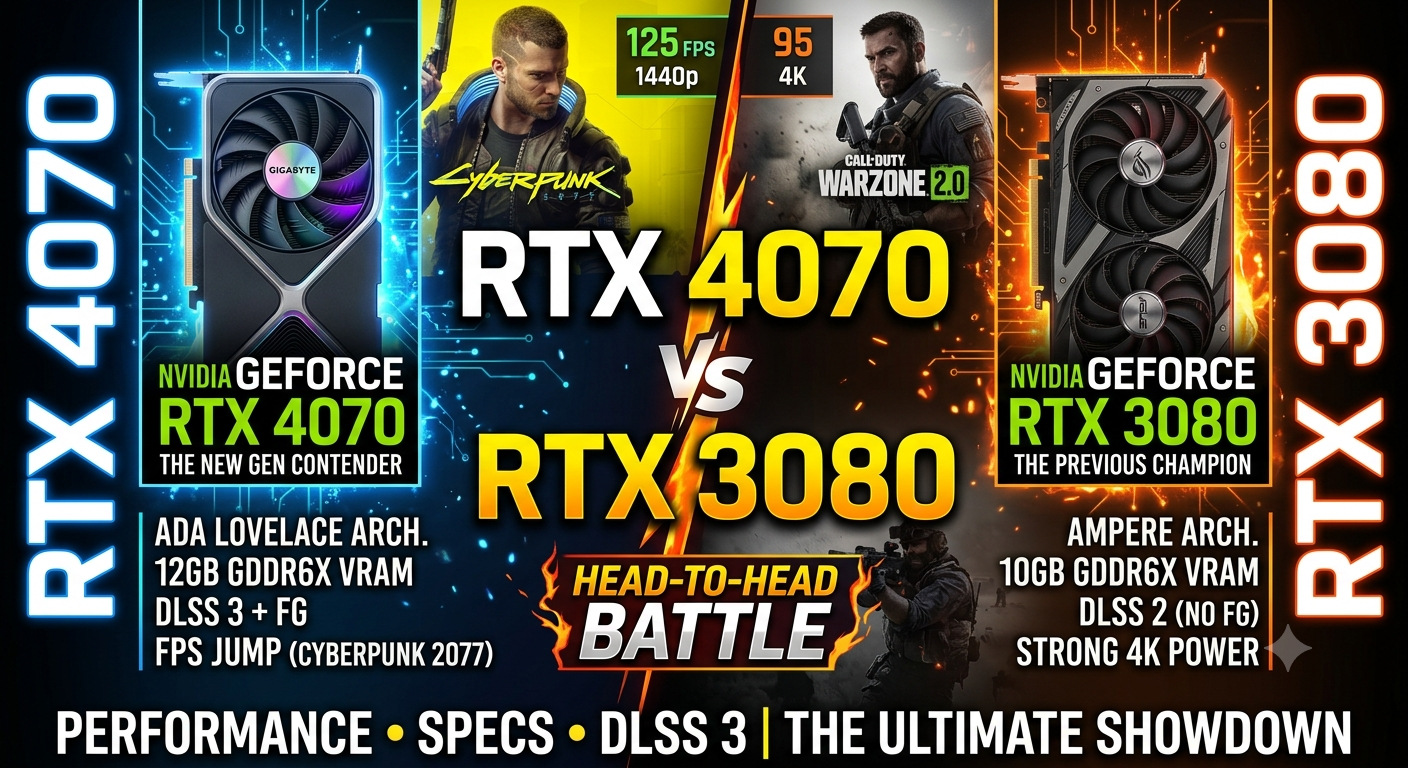
In raw rasterisation performance, the RTX 4070 and RTX 3080 are closely matched in 2026 the 4070 edges ahead by approximately 5–10% in most modern titles. However, the RTX 4070's real advantage comes from DLSS 3 Frame Generation and better power efficiency: DLSS 3 can nearly double effective FPS in supported titles, widening the practical performance gap to 30–60% in those games. For new buyers in 2026, the RTX 4070 is the stronger choice. For existing RTX 3080 owners, an upgrade purely for rasterisation FPS is hard to justify.
Use the FPS calculator with your specific CPU to see the estimated FPS for each GPU at your target resolution before making any purchase decision.
Specification Comparison
| Spec | RTX 4070 | RTX 3080 (10GB) |
|---|---|---|
| Architecture | Ada Lovelace | Ampere |
| CUDA Cores | 5,888 | 8,704 |
| VRAM | 12GB GDDR6X | 10GB GDDR6X |
| Memory Bus | 192-bit | 320-bit |
| Memory Bandwidth | 504 GB/s | 760 GB/s |
| TDP | 200W | 320W |
| DLSS Version | DLSS 3 (Frame Gen) | DLSS 2 (no Frame Gen) |
| Ray Tracing Gen | 3rd gen RT | 2nd gen RT |
| Release Year | 2023 | 2020 |
Despite having fewer CUDA cores, the RTX 4070's Ada Lovelace architecture is significantly more efficient per core than Ampere. The RTX 3080's wider memory bus gives it a bandwidth advantage that helps in very VRAM-heavy scenarios, but the 4070's 12GB vs the 3080's 10GB is the more relevant VRAM story in 2026 — more titles are bumping against 10GB limits.
Raw FPS Comparison by Resolution
Estimated native rasterisation performance (without upscaling), assuming a matched mid-high-range CPU and high settings:
| Resolution | RTX 4070 (Est.) | RTX 3080 10GB (Est.) | Gap |
|---|---|---|---|
| 1080p High | Very High FPS | High FPS | RTX 4070 ~5–10% ahead |
| 1440p Ultra | High FPS | High FPS | RTX 4070 ~5–10% ahead |
| 4K High | Moderate FPS | Moderate FPS | RTX 4070 ~5–10% ahead |
For exact estimates with your specific CPU, use the FPS calculator the CPU adjustment matters here, particularly at 1080p where the CPU tier has a significant impact on both cards' delivered FPS.
- Specification Comparison
- Raw FPS Comparison by Resolution
- Where the RTX 4070 Opens a Larger Lead
- DLSS 3 Frame Generation
- Ray Tracing
- Power Efficiency
- Where the RTX 3080 Holds Its Own
- Memory Bandwidth in Very Demanding Scenarios
- Native Rasterisation Parity in Older Titles
- CPU Pairing Considerations for Each Card
- Should RTX 3080 Owners Upgrade to RTX 4070 in 2026?
- For New Buyers: RTX 4070 vs RTX 3080 on the Used Market
- Key Takeaways
Where the RTX 4070 Opens a Larger Lead
DLSS 3 Frame Generation
The RTX 4070 supports DLSS 3, including Frame Generation — a feature that uses the GPU's optical flow accelerator to generate additional frames between rendered frames. In supported titles:
- Frame Generation typically adds 40–80% more effective FPS
- An RTX 4070 at 80 native FPS with Frame Generation active can display at 130–145 effective FPS
- An RTX 3080, limited to DLSS 2, gains no Frame Generation benefit and stays at 80 native FPS
In DLSS 3-supported games (which now include hundreds of titles), the effective FPS gap between the RTX 4070 and RTX 3080 grows from 5–10% to potentially 50–80%.
Ray Tracing
RTX 4070's 3rd-generation RT cores are meaningfully more efficient than the RTX 3080's 2nd-generation hardware. In ray-tracing-heavy titles:
- RTX 4070 pulls ahead by 15–25% in RT-heavy scenarios
- At 4K with path tracing (Cyberpunk 2077, Alan Wake 2), the 3rd-gen RT advantage is substantial
Power Efficiency
The RTX 4070 draws 200W vs the RTX 3080's 320W. For the same or better rasterisation FPS, the 4070 uses 37% less power meaningfully cheaper to run and producing less heat for case thermal management.
Where the RTX 3080 Holds Its Own
Memory Bandwidth in Very Demanding Scenarios
The RTX 3080's 760 GB/s memory bandwidth vs the 4070's 504 GB/s gives it an advantage in scenarios that are genuinely bandwidth-constrained certain GPU-compute tasks, very high-resolution texture streaming, and some professional workloads. In typical gaming at 1440p and below, this advantage rarely materialises.
Native Rasterisation Parity in Older Titles
In games released before 2022, the RTX 3080's Ampere architecture sometimes matches or slightly exceeds the RTX 4070 in specific benchmarks Ampere was well-optimised for that era's games. In 2026 titles, Ada Lovelace's optimisations pull the 4070 ahead.
CPU Pairing Considerations for Each Card
Both cards require similar CPU tiers to avoid a significant CPU bottleneck:
- At 1080p: Core i5-13600K / Ryzen 5 7600X or better for each card
- At 1440p: Either card pairs well with a wider range of CPUs; Core i5-13600K is adequate
- At 4K: Both cards are GPU-limited; most modern 6-core CPUs pair adequately
Check the bottleneck calculator with your CPU and each GPU to confirm which card creates a more favourable bottleneck ratio with your specific processor for some CPU/resolution combinations, the difference is negligible.
Should RTX 3080 Owners Upgrade to RTX 4070 in 2026?
Honest answer: generally no, for pure rasterisation FPS improvement:
- A 5–10% rasterisation FPS gain doesn't justify the cost of a GPU upgrade for a functional system
- The 3080 is not GPU-limited in any meaningful way at 1440p in most 2026 titles if performance feels inadequate, the CPU or settings are more likely the cause
Consider upgrading if:
- You specifically want DLSS 3 Frame Generation for supported titles this is the most compelling reason to move to RTX 40-series from an RTX 3080
- Your RTX 3080 is hitting VRAM limits (10GB is increasingly tight in 2026 at 1440p ultra in texture-heavy games)
- Power consumption is a real concern saving 120W per gaming session adds up over years
Use the Compare Systems tool to model the FPS difference between the RTX 3080 and RTX 4070 with your specific CPU before deciding.
For New Buyers: RTX 4070 vs RTX 3080 on the Used Market
In 2026, RTX 3080 units are available on the used market at prices that undercut the RTX 4070's new price. For buyers comparing new RTX 4070 vs used RTX 3080:
- New RTX 4070: DLSS 3, better RT, longer driver support, warranty, lower power draw, 12GB VRAM
- Used RTX 3080: Lower upfront cost, wider 320-bit bus, DLSS 2 only, no Frame Generation, 10GB VRAM increasingly limiting, no warranty
For most buyers, the new RTX 4070's total value package especially DLSS 3 Frame Generation and longer relevance makes it the better choice unless the price gap is very significant. Check current pricing in your market and run both cards through the FPS calculator with your CPU to see the estimated FPS difference for your specific use case.
Key Takeaways
- The RTX 4070 leads the RTX 3080 by 5–10% in native rasterisation; the gap grows to 50–80% effective FPS in DLSS 3 Frame Generation-supported titles.
- RTX 3080 owners should not upgrade purely for rasterisation FPS the gain doesn't justify the cost. DLSS 3 Frame Generation and VRAM limits are the more compelling reasons.
- For new buyers choosing between new RTX 4070 and used RTX 3080, the RTX 4070's DLSS 3, driver longevity, and 12GB VRAM generally make it the better total-value choice.
- Both cards have similar CPU requirements; use the FPS calculator with your specific CPU to see the estimated FPS difference.
- Use the Compare Systems tool to compare both GPUs with your CPU before making a final decision.