How to Calculate Linear Feet: A Complete Step-by-Step Guide
Introduction
Whether you are planning a home renovation, buying lumber, installing flooring, or measuring fencing, knowing how to calculate linear feet is an essential skill. Many people confuse linear feet with square feet or cubic feet, which can lead to costly mistakes on projects.
This guide explains exactly what linear feet are, how to calculate them with a simple formula, and how to apply them in everyday situations. By the end of this article, you will be able to measure linear footage confidently for any project.
What Are Linear Feet?
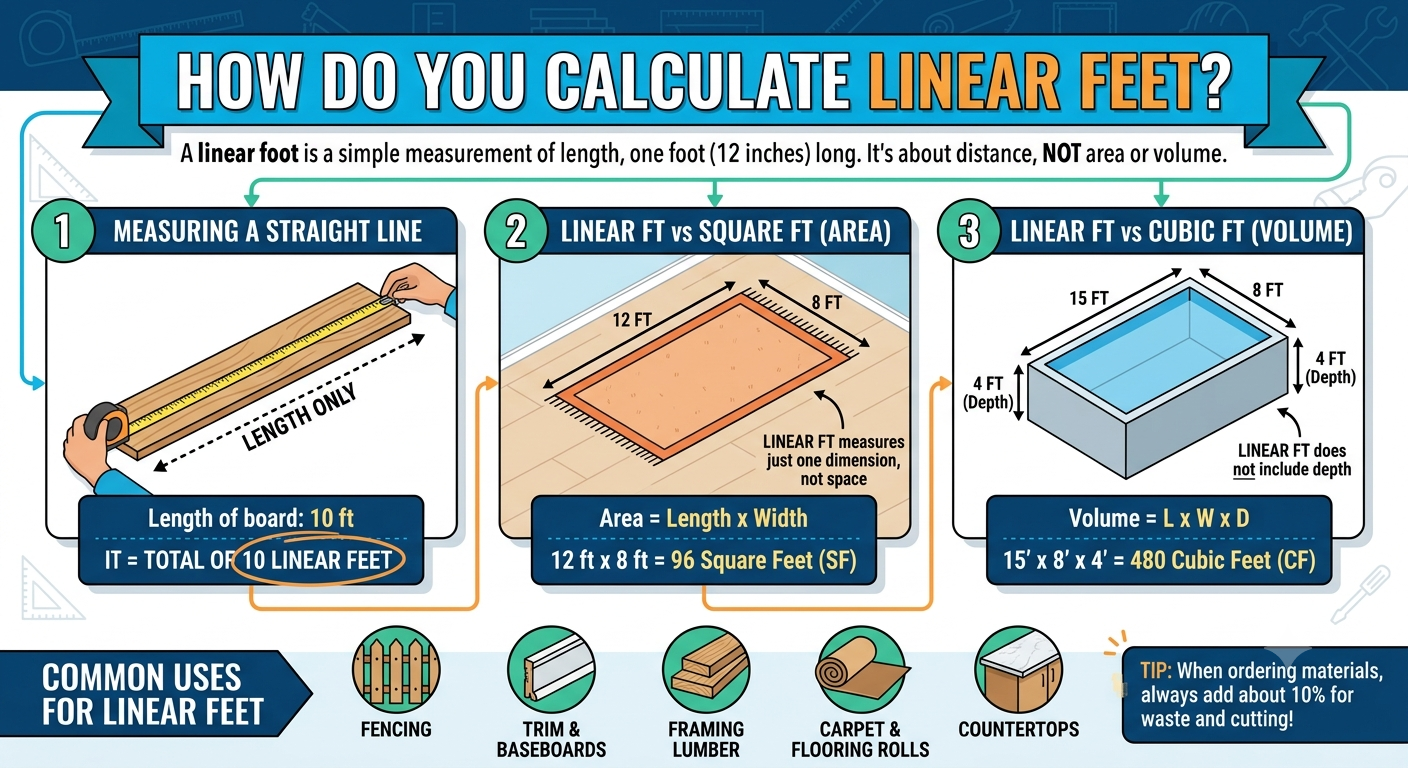
A linear foot is simply a straight-line measurement of length equal to 12 inches or 30.48 centimetres. The word "linear" means in a straight line. Unlike square feet (which measure area) or cubic feet (which measure volume), linear feet measure only one dimension: length.
Linear feet are commonly used in construction, woodworking, fabric industries, and home improvement projects where only the length of a material matters, not its width or height.
|
Measurement Type |
Dimensions |
Common Use |
|
Linear Feet |
1D (Length only) |
Lumber, piping, fabric |
|
Square Feet |
2D (Length x Width) |
Flooring, roofing, walls |
|
Cubic Feet |
3D (L x W x H) |
Mulch, concrete, gravel |
The Linear Feet Formula
The formula for calculating linear feet is very straightforward:
Linear Feet = Total Length (in inches) ÷ 12
If your measurement is already in feet, no conversion is needed. Simply add up all the lengths in feet to get the total linear footage.
Step-by-Step Calculation
1. Measure the total length of the object or space in inches.
2. Divide the total inches by 12 to convert to feet.
3. If you have multiple pieces, add all lengths together.
4. The result is your total linear footage.
Practical Examples of Calculating Linear Feet
Example 1: Measuring Lumber
Suppose you need to buy boards for a fence. You have four boards, each measuring 96 inches (8 feet) long.
Calculation: 4 boards x 96 inches = 384 total inches. Then 384 ÷ 12 = 32 linear feet. You would need to purchase 32 linear feet of lumber.
Example 2: Measuring Fabric
You want to buy curtain fabric. Each panel needs to be 84 inches long, and you need 3 panels.
Calculation: 3 panels x 84 inches = 252 total inches. Then 252 ÷ 12 = 21 linear feet of fabric required.
Example 3: Measuring Baseboard Trim
You are installing baseboard trim in a room with walls measuring 10 ft, 12 ft, 10 ft, and 12 ft.
Calculation: 10 + 12 + 10 + 12 = 44 linear feet. You should purchase at least 44 linear feet of trim, plus 10% extra for waste.
Example 4: Measuring a Fence Line
Your yard perimeter measures 180 inches on one side and 240 inches on another.
Calculation: (180 + 240) ÷ 12 = 420 ÷ 12 = 35 linear feet total.
When Do You Use Linear Feet?
Linear feet are used across many industries and home improvement projects. Common applications include:
• Lumber and timber purchasing at hardware stores
• Flooring installation for hardwood, laminate, or vinyl planks
• Fencing and railing measurements
• Piping, conduit, and cable runs
• Fabric, ribbon, and textile measurements
• Kitchen cabinets and countertop pricing
• Gutter and trim installation
• Crown moulding and baseboard installation
Pro Tips for Accurate Linear Feet Calculations
• Always measure twice before cutting or ordering materials.
• Add 10 to 15 percent extra material to account for cuts, waste, and errors.
• Write measurements down as you go to avoid mistakes.
• Use a quality tape measure for best accuracy.
• For irregular shapes, break them into smaller straight sections and measure each one separately.
• When in doubt, convert all measurements to inches first, then divide by 12 for a clean result.
Linear Feet vs Square Feet: Key Differences
One of the most common points of confusion is the difference between linear feet and square feet. Here is a simple comparison:
Linear feet measure only length in a straight line. You use linear feet when width does not change or does not matter, such as when buying lumber sold at a standard width, or measuring cable.
Square feet measure area (length multiplied by width). You use square feet when you need to cover a surface, such as flooring, painting walls, or installing tiles.
Example: If you need baseboard trim, you calculate in linear feet because the trim has a fixed width. But if you need flooring, you calculate in square feet because you need to cover the entire floor area.
Quick Conversion Reference Table
|
Inches |
Linear Feet |
Yards |
|
12 inches |
1 linear foot |
0.33 yards |
|
24 inches |
2 linear feet |
0.67 yards |
|
36 inches |
3 linear feet |
1 yard |
|
48 inches |
4 linear feet |
1.33 yards |
|
60 inches |
5 linear feet |
1.67 yards |
|
72 inches |
6 linear feet |
2 yards |
|
96 inches |
8 linear feet |
2.67 yards |
|
120 inches |
10 linear feet |
3.33 yards |
Conclusion
Calculating linear feet is one of the simplest and most useful measurement skills you can learn. Whether you are measuring lumber for a fence, fabric for curtains, or trim for your home, the formula is always the same: divide total inches by 12 to get linear feet.
Remember to always measure twice, add a 10 to 15 percent waste buffer, and write down your measurements to avoid errors. With practice, calculating linear footage will become second nature for all your DIY and professional projects.
Use this guide as a reference anytime you need to quickly and accurately calculate linear feet for any project.