How to Calculate Amps: A Simple Step by Step Guide for Beginners
Whether you are setting up a home electrical system, troubleshooting a circuit, or choosing the right fuse for your device, knowing how to calculate amps is a fundamental skill. In this guide you will learn the exact formulas, step by step methods, and real world examples that make amp calculations simple and fast.
What Is an Amp?
An ampere (commonly shortened to amp) is the standard unit of electric current. It measures how much electrical charge flows through a conductor per second. Think of it like water flowing through a pipe: voltage is the water pressure and amps are the flow rate.
Understanding amps helps you avoid overloaded circuits, blown fuses, and potential fire hazards in your home or workplace.
The Basic Formula to Calculate Amps
The most widely used formula for calculating amps comes from Ohm Law. It states that current equals voltage divided by resistance.
- What Is an Amp?
- The Basic Formula to Calculate Amps
- How to Calculate Amps from Watts and Volts
- Step by Step Guide to Calculate Amps
- Practical Examples
- Example 1: Calculating Amps from Watts
- Example 2: Calculating Amps Using Ohm Law
- Example 3: Home Air Conditioner
- Quick Reference: Amps Formula Chart
- Safety Tips When Working with Electrical Current
Amps (I) = Voltage (V) / Resistance (Ohm)
Ohm Law I = V / R
Where I stands for current in amps, V stands for voltage in volts, and R stands for resistance in ohms. This formula applies to most basic electrical circuits.
How to Calculate Amps from Watts and Volts
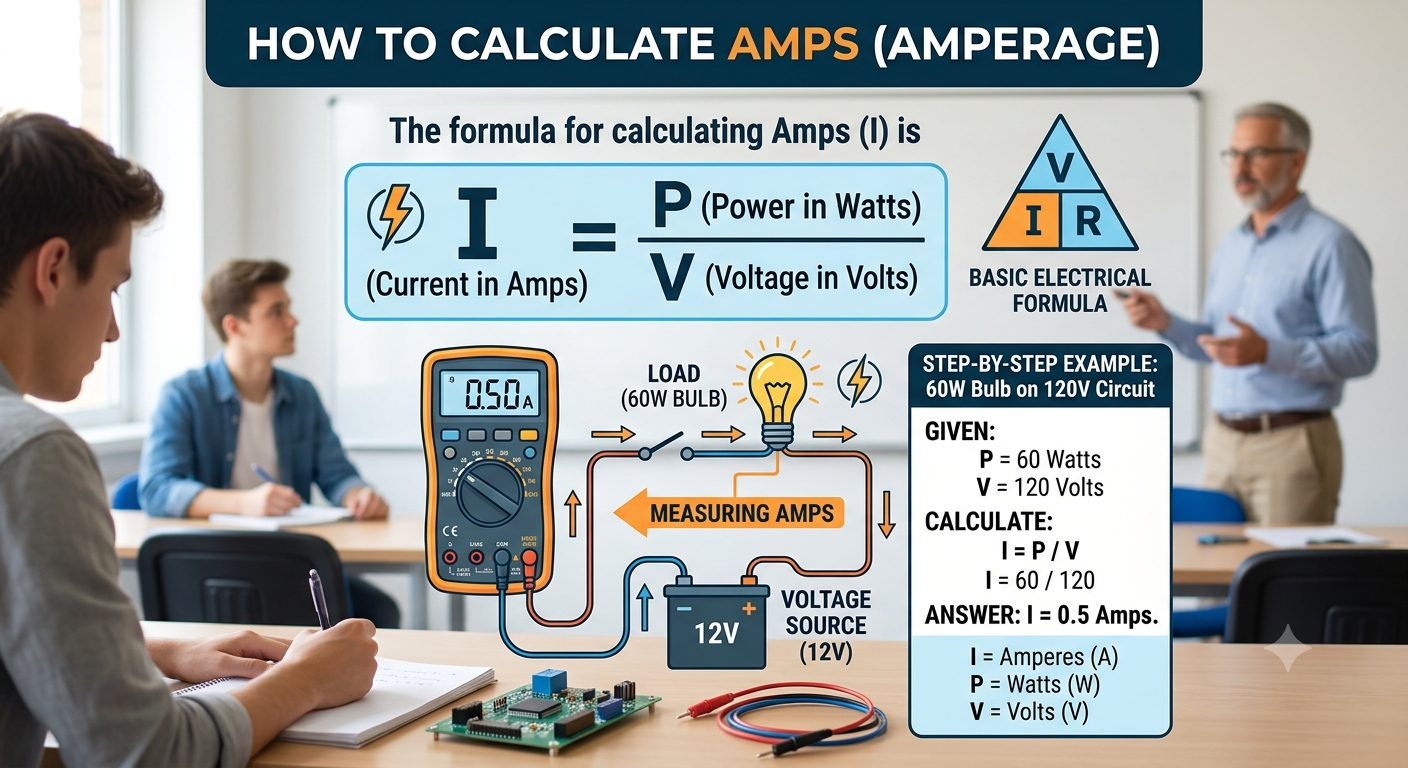
If you know the power in watts and voltage of a device you can calculate the amps it draws using this formula:
Amps (I) = Power (W) / Voltage (V)
Power Formula I = P / V
This method is especially useful when reading appliance labels. Most electrical devices list their wattage and operating voltage directly on the product.
Step by Step Guide to Calculate Amps
1. Find the Voltage: Check your power source. Standard home outlets supply 120V or 240V depending on your country.
2. Find the Wattage or Resistance: Look at the device label for wattage. For circuits measure resistance in ohms using a multimeter.
3. Apply the Formula: Use I = P / V if you have watts and volts. Use I = V / R if you have volts and ohms.
4. Verify the Result: Compare your result with the device rating. A significant difference may signal a wiring issue.
Practical Examples
Example 1: Calculating Amps from Watts
A microwave oven uses 1200 watts and runs on a 120V outlet. To find the amps it draws:
I = 1200W / 120V = 10 Amps
Example 2: Calculating Amps Using Ohm Law
A circuit has a voltage of 240V and a resistance of 60 ohms. To find the current:
I = 240V / 60 Ohm = 4 Amps
Example 3: Home Air Conditioner
An air conditioner rated at 2000 watts plugs into a 240V outlet.
I = 2000W / 240V = 8.33 Amps
Quick Reference: Amps Formula Chart
I = V / R Use when you know voltage and resistance.
I = P / V Use when you know watts and voltage.
I = sqrt(P / R) Use when you know power and resistance only.
Safety Tips When Working with Electrical Current
Always turn off power at the breaker before working on a circuit. Even low amp circuits can cause serious injury if handled improperly.
Always use a certified multimeter to verify readings before touching any live wires. If your calculated amps exceed the circuit breaker rating do not proceed without consulting a licensed electrician.
Overloaded circuits are a leading cause of household electrical fires. Knowing how to calculate amps correctly is one of the best ways to keep your home safe.