80+ Gold vs Bronze vs Platinum PSU: Which Should You Buy?
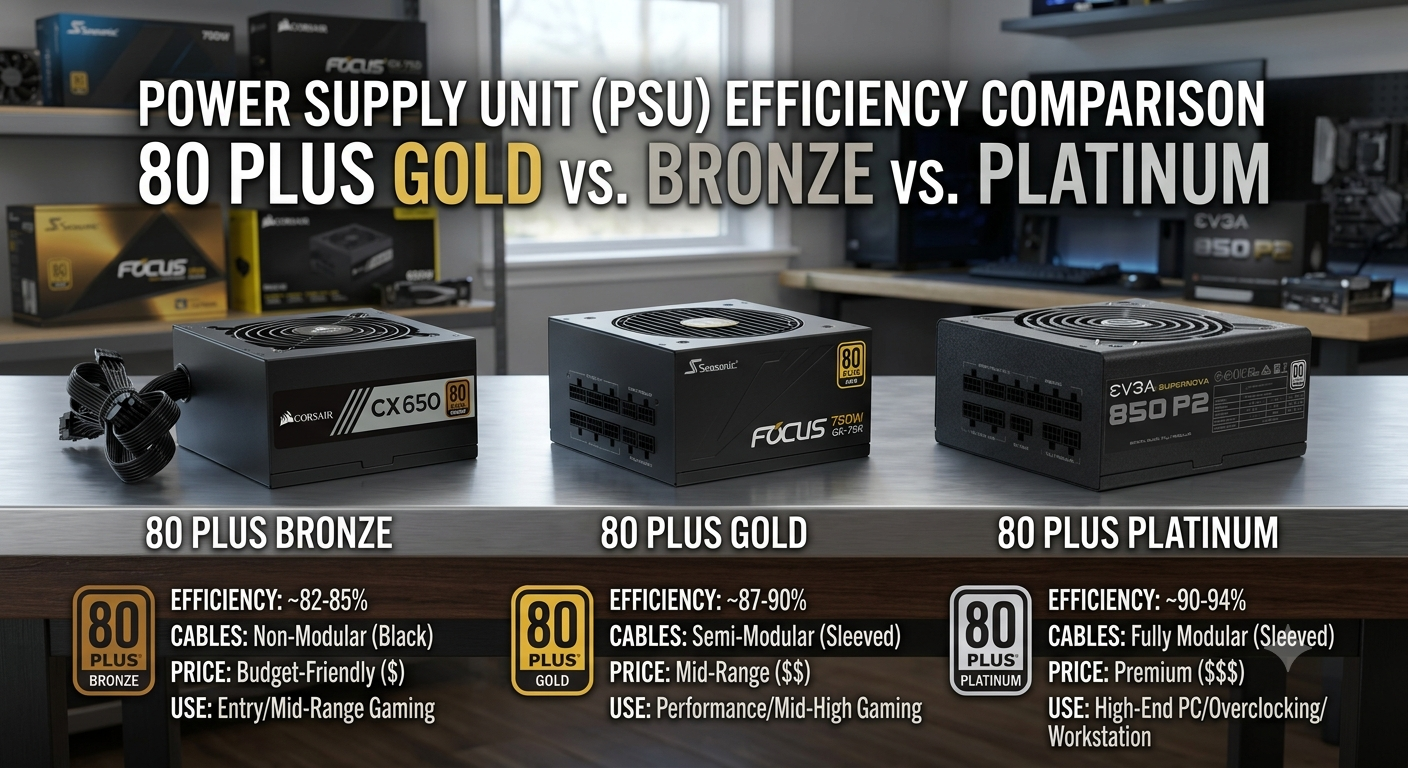
For most gaming PCs in 2026, 80+ Gold is the best value PSU efficiency tier it offers meaningfully better efficiency than Bronze without the cost premium of Platinum or Titanium. 80+ Bronze is acceptable for tight budgets on lower-power builds. 80+ Platinum is worth considering for high-TDP flagship builds (RTX 4090, i9-14900K) where the extra efficiency saves measurable electricity over time. 80+ Titanium is rarely worth its significant price premium for a consumer gaming build.
Use the PSU calculator to confirm the right wattage for your build before choosing an efficiency tier getting the wattage right matters more than the efficiency tier.
What 80+ Certification Actually Means
The 80+ program certifies that a PSU delivers at least 80% efficiency at 20%, 50%, and 100% of its rated load. "Efficiency" means the ratio of output power (delivered to your components) to input power (drawn from the wall). The remainder becomes heat inside the PSU.
A 1000W 80% efficient PSU delivering 800W to your system draws 1000W from the wall 200W becomes heat inside the PSU unit itself. A 90% efficient version delivering the same 800W only draws 889W from the wall 89W becomes heat.
This matters for three reasons: electricity cost, PSU operating temperature (affects longevity), and how much heat the PSU adds to your case's thermal environment.
Efficiency at Each Load Level by Tier
| Rating | 20% Load | 50% Load | 100% Load | Typical Use for Gaming |
|---|---|---|---|---|
| 80+ (no tier) | 80% | 80% | 80% | Baseline — rarely seen in modern PSUs |
| 80+ Bronze | 82% | 85% | 82% | Budget tier; acceptable for low-power builds |
| 80+ Silver | 85% | 88% | 85% | Uncommon; most brands skip this tier |
| 80+ Gold | 87% | 90% | 87% | ✅ Best value for most builds |
| 80+ Platinum | 90% | 92% | 89% | Best for high-power or long-running systems |
| 80+ Titanium | 92% | 94% | 90% | Premium; rarely recovers cost premium for gaming |
Gaming PCs spend most of their time running at 40–70% of PSU capacity during actual gaming sessions (idle and light loads are much lower). This means the 50% load efficiency figure is the most relevant for real-world gaming use.
Real-World Electricity Cost Difference
The efficiency difference between Bronze and Gold translates to a small but real electricity cost difference over time. For a typical gaming build drawing 400W from your components (a 500W load from the wall at 80% efficiency vs a 444W load at 90%):
| Tier | Wall Draw (for 400W delivered) | Hours per Year (500hrs gaming) | Annual Electricity Cost (at $0.15/kWh) |
|---|---|---|---|
| 80+ Bronze (85% at 50%) | ~470W | 500hrs | ~$35.25 |
| 80+ Gold (90% at 50%) | ~444W | 500hrs | ~$33.30 |
| 80+ Platinum (92% at 50%) | ~435W | 500hrs | ~$32.60 |
| 80+ Titanium (94% at 50%) | ~426W | 500hrs | ~$31.95 |
The annual electricity saving from Gold vs Bronze is roughly $2/year at 500 gaming hours. From Gold to Platinum, it's another $0.70/year. These savings don't recover a $40–$80 price premium between tiers the real value of higher efficiency ratings is lower operating temperature and potentially longer PSU lifespan, not electricity savings alone.
At higher power builds (RTX 4090 + i9-14900K drawing 700W+ continuously), the numbers scale up proportionally, making Platinum more justifiable for flagship builds running significant hours.
Which Tier Is Right for Each Build?
| Build Tier | Draw at Load | Best Efficiency Tier | Why |
|---|---|---|---|
| Budget 1080p (RTX 4060 + i3/i5) | 250–350W | 80+ Bronze or Gold | Low draw; tier difference is minimal |
| Mid-Range 1440p (RTX 4070 + i5) | 350–450W | 80+ Gold | Best value; Gold's efficiency sweet spot |
| High-End 1440p (RTX 4070 Ti Super + i7) | 400–520W | 80+ Gold | Still Gold territory |
| Flagship 4K (RTX 4080 Super + i9) | 480–600W | 80+ Gold or Platinum | Platinum justifiable at this draw level |
| Extreme (RTX 4090 + i9/Ryzen 9) | 580–750W | 80+ Platinum | Higher sustained draw makes Platinum worthwhile |
What 80+ Doesn't Tell You
The 80+ certification only measures efficiency — it says nothing about:
- Build quality — capacitor grade, PCB design, and component quality vary enormously within the same efficiency tier
- Ripple and noise — a poorly built 80+ Gold PSU can have worse voltage regulation than a well-built 80+ Bronze
- Transient response — how well the PSU handles sudden spikes in demand (relevant for RTX 4090 builds)
- Warranty length — top-tier PSU manufacturers offer 7–10 year warranties; budget units often 3 years or less
An 80+ Gold certification from a budget manufacturer is not equivalent to an 80+ Gold certification from an established brand. Always pair the efficiency tier selection with a reputable brand choice.
How to Choose: A Practical Decision Tree
- Determine your wattage first use the PSU calculator to find the right wattage before thinking about tier
- Budget builds (under $800 total build): 80+ Bronze is acceptable; Gold is better if within $10–15 budget
- Mid-range builds ($800–$1500): 80+ Gold minimum; worth paying a small premium over Bronze
- High-end builds ($1500–$2500): 80+ Gold standard; Platinum if the system will run many hours
- Flagship builds ($2500+, RTX 4090/4080 Super): 80+ Platinum recommended; the higher sustained draw makes it worthwhile over the build's lifetime
The Most Common Efficiency Tier Mistake
Paying for 80+ Titanium certification on a build that draws 350W at load. A 1000W Titanium PSU running at 35% capacity doesn't deliver its rated efficiency (Titanium's 94% efficiency is certified at 50% load). Below 20% load, efficiency drops for all tiers — and a massively oversized PSU running a light system is wasteful regardless of its certification.
Size the PSU correctly first (per the how much PSU do I need guide) then choose the efficiency tier. In that order, not the other way around.
Key Takeaways
- 80+ Gold is the best value efficiency tier for the majority of gaming builds he sweet spot between cost and efficiency benefit.
- 80+ Bronze is acceptable for budget and low-power builds where the efficiency difference is minimal in real-world savings.
- 80+ Platinum is worth considering for high-power flagship builds (RTX 4090/4080 Super + i9/Ryzen 9) where sustained higher draw makes the efficiency improvement more meaningful.
- 80+ Titanium is rarely worth its premium for consumer gaming builds the efficiency difference over Platinum is marginal.
- Efficiency certification only measures one dimension build quality, capacitor grade, and brand reliability matter equally and aren't captured by the 80+ rating alone.
- Always determine the correct wattage in the PSU calculator before selecting an efficiency tier.