RAM Bottleneck: Can Memory Slow Down Your CPU and GPU?
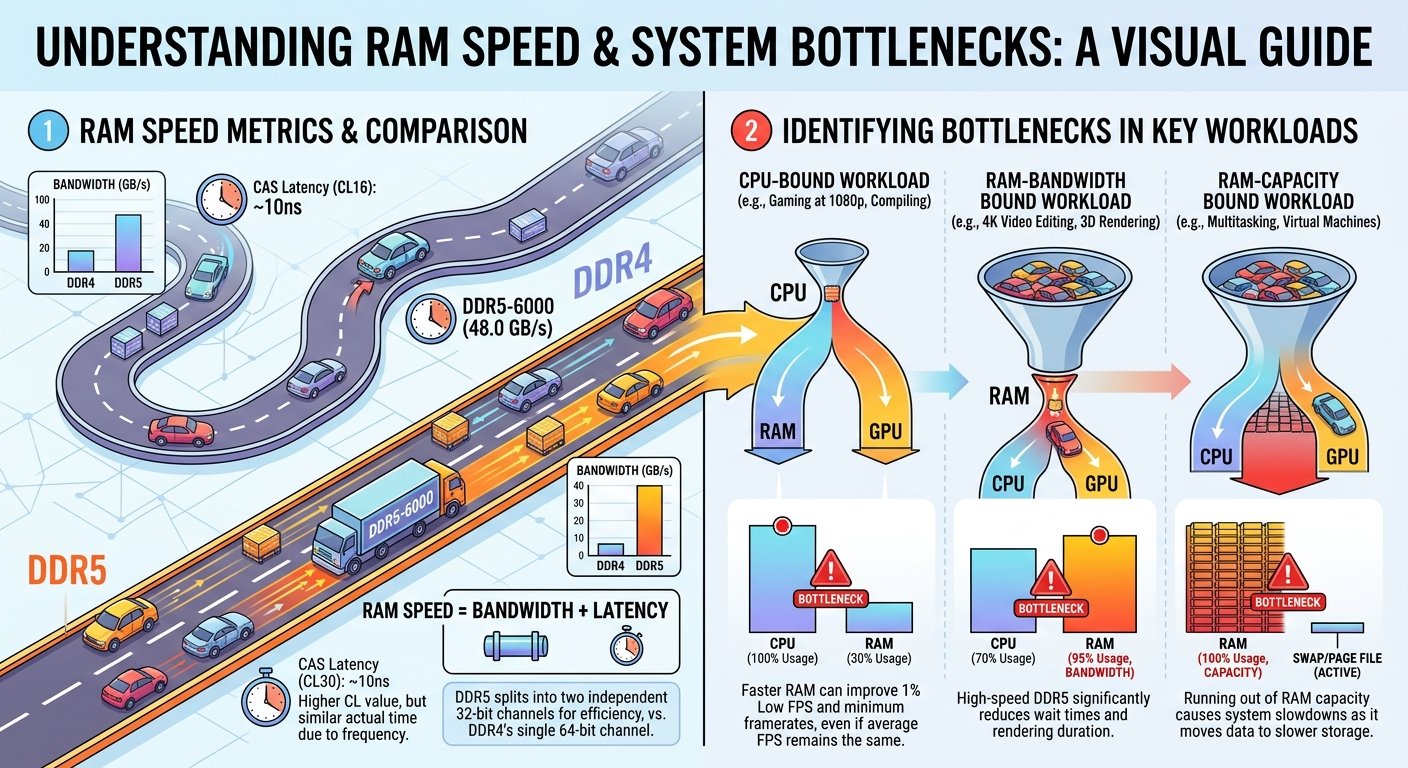
Yes — a RAM bottleneck happens when insufficient memory capacity or slow memory speed forces your CPU and GPU to wait for data, reducing performance regardless of how powerful either component is. Unlike a CPU or GPU bottleneck, which is about one part outpacing another, a RAM bottleneck affects the entire system at once, since both the processor and graphics card depend on memory to do their jobs.
How RAM Fits Into the Bottleneck Picture
CPU and GPU bottlenecks describe an imbalance between two components. A RAM bottleneck is different — it's a shortage that limits everything relying on it. When your system runs out of available memory or can't move data through RAM fast enough, both your CPU and GPU end up waiting on information they need to keep working, even if neither component is individually weak.
Two Separate Issues: Capacity vs Speed
RAM Capacity (How Much You Have)
This is the more common and more damaging issue. If your installed RAM can't hold everything your game or application needs at once, your system has to constantly swap data in and out of slower storage, causing stutter and frame drops.
· 8GB is now considered insufficient for most modern AAA games in 2026 and frequently causes a noticeable bottleneck.
- How RAM Fits Into the Bottleneck Picture
- Two Separate Issues: Capacity vs Speed
- RAM Capacity (How Much You Have)
- RAM Speed (How Fast Data Moves)
- Signs You Have a RAM Bottleneck
- RAM Bottleneck vs CPU/GPU Bottleneck: How They Interact
- How Much RAM Do You Actually Need?
- How to Fix a RAM Bottleneck
- Key Takeaways
· 16GB is the realistic minimum for smooth modern gaming and general multitasking.
· 32GB provides comfortable headroom for gaming alongside streaming, heavy multitasking, or content creation.
RAM Speed (How Fast Data Moves)
Even with enough capacity, slow RAM speed (or RAM running below its rated speed because XMP/EXPO wasn't enabled) can create a smaller but still measurable bottleneck, particularly noticeable with certain CPU architectures that are more sensitive to memory bandwidth.
Signs You Have a RAM Bottleneck
· Stuttering that appears specifically when switching scenes, loading new areas, or alt-tabbing between applications
· Performance that degrades the longer a game session runs (memory filling up over time)
· Lower frame rates than benchmarks suggest, even though your CPU and GPU calculator result shows a low bottleneck percentage between them
· Noticeably better performance after closing background browser tabs or apps
RAM Bottleneck vs CPU/GPU Bottleneck: How They Interact
A bottleneck calculator primarily measures the CPU-to-GPU relationship, but RAM capacity is factored in because it can introduce a separate limiting effect. This means it's possible to have:
· A low CPU/GPU bottleneck percentage and still experience poor performance because of insufficient RAM
· A genuinely well-matched CPU and GPU that appear to underperform purely because 8GB of RAM can't keep pace with a modern game's memory demands
This is why entering your actual RAM size into the calculator not skipping that field matters for getting a realistic picture of your system's performance ceiling.
How Much RAM Do You Actually Need?
|
Use Case |
Recommended RAM |
|
Light gaming, older titles |
8–16GB |
|
Modern AAA gaming (2024–2026 titles) |
16GB minimum |
|
Gaming + streaming/Discord/browser multitasking |
32GB |
|
Content creation, video editing, 3D rendering |
32GB+ |
How to Fix a RAM Bottleneck
1. Upgrade capacity first if you're running 8GB this is the single highest-impact RAM change available.
2. Enable XMP or EXPO in your BIOS to ensure your RAM runs at its rated speed rather than a slower default.
3. Run RAM in dual-channel mode (two matched sticks rather than one) single-channel configurations underperform even with the same total capacity.
4. Close unnecessary background applications before gaming or rendering sessions to free up available memory.
5. Re-check your build in the Compare Systems tool after a RAM upgrade to see the updated performance picture alongside your CPU and GPU.
Key Takeaways
· A RAM bottleneck limits both your CPU and GPU simultaneously, unlike a CPU or GPU bottleneck which describes an imbalance between the two.
· Capacity matters most 8GB is now commonly insufficient, while 16GB is the realistic baseline for modern gaming.
· RAM speed and dual-channel configuration offer smaller, secondary performance benefits once capacity is sufficient.
· Always enter your actual RAM size into a bottleneck calculator for a complete, realistic performance picture.
· Upgrading from 8GB to 16GB is often the single highest-impact, lowest-cost upgrade available for a stuttering system.