AMD vs Intel in 2026: Which Platform Bottlenecks Less?
Neither AMD nor Intel is universally better at avoiding bottlenecks the answer depends on resolution, game type, and which specific generation of chip you're comparing. In 2026, AMD's Ryzen 7000 and 9000 series (particularly the 3D V-Cache variants) lead in gaming-specific CPU performance for most paired configurations, while Intel's current-generation Core Ultra chips offer competitive multi-threaded performance that narrows the gap in productivity and mixed workloads. The right platform choice depends on what you're optimizing for and which GPU you're pairing.
What Bottlenecks Less Actually Means for a Platform
When comparing AMD and Intel for bottleneck potential, the relevant question is: which CPU, at the same price point and paired with the same GPU, leaves less GPU performance on the table? A CPU that can feed your GPU faster and more consistently produces a smaller CPU bottleneck percentage which is what "bottlenecks less" means in practical terms.
This is best evaluated by running specific CPU models head-to-head in the Compare Systems tool rather than relying on platform-level generalizations.
Where AMD Currently Has an Advantage
Gaming-Specific Performance With 3D V-Cache
AMD's 3D V-Cache technology (used in chips like the Ryzen 7 7800X3D and Ryzen 9 9950X3D) dramatically increases the CPU's on-chip cache, which reduces the number of times the processor has to reach out to slower main memory for game data. This has a direct, measurable impact on CPU bottleneck size in gaming scenarios particularly at 1080p, where the CPU is under the most pressure.
In high-refresh-rate 1080p gaming, a Ryzen 7800X3D-class CPU consistently produces smaller CPU bottleneck percentages than comparably priced Intel chips against the same GPU. For competitive gaming at maximum frame rates, this is AMD's clearest platform advantage.
- What Bottlenecks Less Actually Means for a Platform
- Where AMD Currently Has an Advantage
- Gaming-Specific Performance With 3D V-Cache
- Power Efficiency Under Gaming Load
- Where Intel Remains Competitive
- Multi-Threaded Productivity Workloads
- Platform and Ecosystem Maturity
- Head-to-Head at Different Resolutions
- Memory Configuration: Where Platform Differences Show Up
- How to Compare Specific Models Head-to-Head
- Budget Tier Comparison: Where Platform Choice Is Most Impactful
- Key Takeaways
Power Efficiency Under Gaming Load
AMD's Zen 4 and Zen 5 architectures tend to deliver gaming performance at lower power draw than Intel's equivalent-tier chips. Lower power draw generally means lower heat, which reduces the risk of thermal throttling creating an artificial bottleneck on top of any hardware mismatch.
Where Intel Remains Competitive
Multi-Threaded Productivity Workloads
Intel's current-generation Core Ultra chips (Meteor Lake and Arrow Lake) include efficient cores (E-cores) alongside performance cores (P-cores), which gives them a core-count advantage in workloads that scale well across many threads including video rendering, compilation, and streaming while gaming.
For users who prioritize productivity alongside gaming, a high-core-count Intel chip can produce a smaller CPU bottleneck in those specific workloads, even if it shows a slightly larger bottleneck in pure gaming scenarios.
Platform and Ecosystem Maturity
Intel's LGA1851 platform is relatively new but has a clear roadmap. For users who prioritize motherboard feature sets, Thunderbolt support, and broader chipset compatibility, Intel's platform ecosystem remains competitive.
Head-to-Head at Different Resolutions
| Resolution | Better Platform for Gaming | Reason |
|---|---|---|
| 1080p high-refresh | AMD (3D V-Cache variants) | Smaller CPU bottleneck due to higher cache capacity |
| 1440p | Roughly equal | GPU workload increases; CPU gap narrows significantly |
| 4K | Effectively equal | GPU is overwhelmingly dominant; CPU platform choice has minimal impact |
At 1440p and above, the platform debate becomes largely irrelevant for gaming the GPU is doing the heavy lifting, and the CPU bottleneck difference between comparable AMD and Intel chips shrinks to single-digit percentages that real-world gameplay can't distinguish.
Memory Configuration: Where Platform Differences Show Up
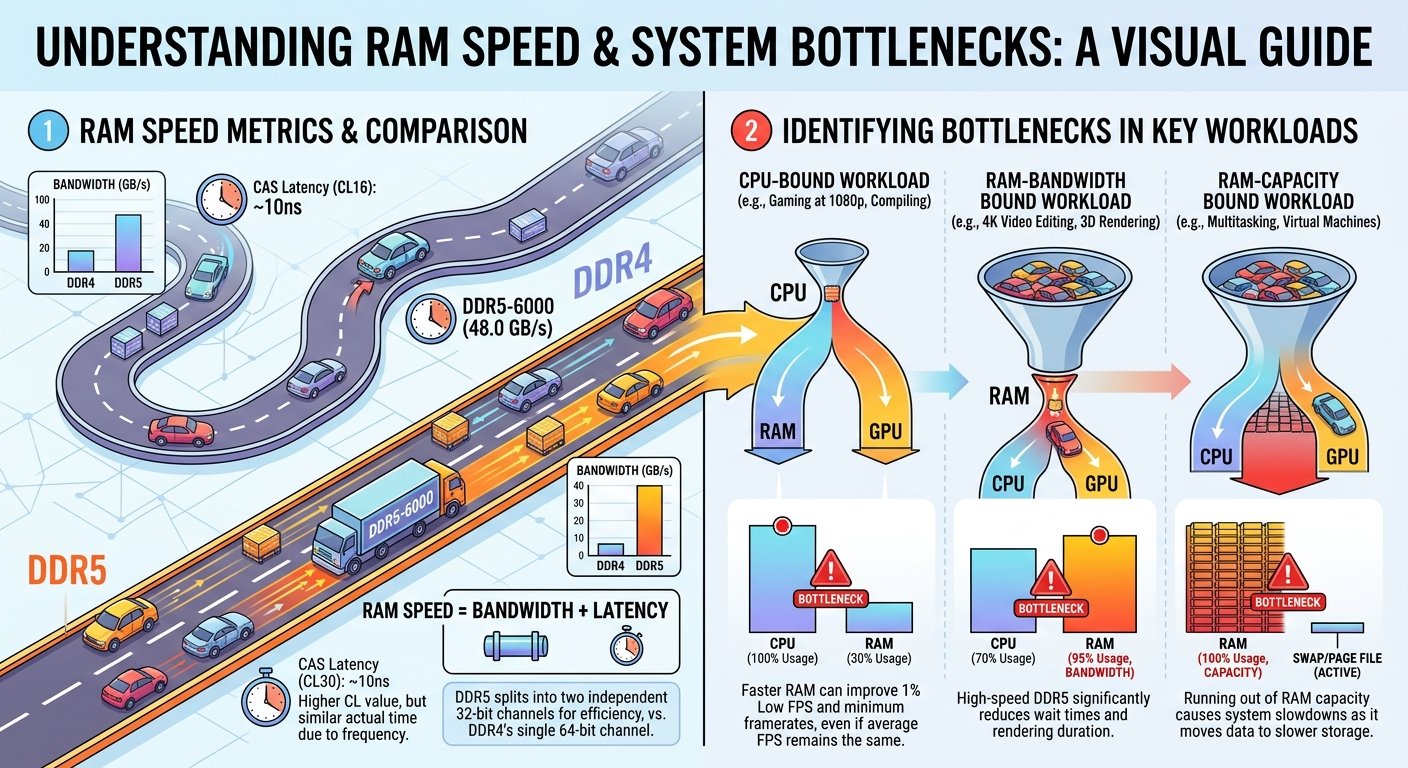
Both AMD AM5 and Intel LGA1851 support DDR5 memory, but they respond differently to memory speed:
- AMD Ryzen 7000/9000 series has a documented sensitivity to memory speed and timing. Enabling EXPO and running DDR5 at 6000MHz is consistently recommended to minimize CPU bottleneck in memory-sensitive games.
- Intel Core Ultra is also DDR5-based and benefits from fast memory, but the performance scaling with memory speed is less dramatic than AMD's, making it slightly more forgiving with slower RAM configurations.
This means an AMD system running RAM below its rated speed can show a larger CPU bottleneck than an equivalently specced Intel system — a factor worth checking before assuming the platform result reflects the CPU's true ceiling.
How to Compare Specific Models Head-to-Head
Platform generalizations only go so far. The most accurate way to evaluate whether a specific AMD or Intel CPU bottlenecks less with your exact GPU and resolution is to run both through the Compare Systems tool side by side. This lets you:
- Test a Ryzen 7 7800X3D against an i7-14700K with your exact GPU
- See which produces a smaller bottleneck percentage at your target resolution
- Compare the result across gaming and professional use cases
This takes less than two minutes and gives you a data-based answer for your specific configuration rather than a platform-level generalization.
Budget Tier Comparison: Where Platform Choice Is Most Impactful
At the budget end of the market, platform differences matter most because budget CPUs from both manufacturers are more likely to produce a meaningful bottleneck with a mid-range GPU. Running specific budget-tier AMD and Intel CPUs through the bottleneck calculator at your target resolution is the most reliable way to identify which platform gives you more performance headroom for a given price.
Key Takeaways
- AMD's 3D V-Cache CPUs produce smaller CPU bottleneck percentages in gaming, particularly at 1080p this is their clearest platform advantage.
- At 1440p and 4K, the AMD vs Intel bottleneck difference narrows to the point of being negligible in most paired configurations.
- Intel remains competitive for multi-threaded productivity workloads and is more forgiving with slower RAM configurations.
- AMD Ryzen 7000/9000 series performs significantly better when RAM is running at its rated speed with EXPO enabled always enable this if you're on an AMD platform.
- Use the Compare Systems tool to compare specific AMD and Intel models head-to-head with your exact GPU before making a platform decision.