What Does GPU Usage Drop Actually Mean?
Your GPU usage percentage visible in tools like MSI Afterburner, GPU-Z, or Task Manager reflects how hard your graphics card is working. A healthy gaming session typically sees GPU usage between 90 99%, meaning the card is fully engaged rendering frames. When usage frequently dips, especially below 70%, it signals that something is preventing the GPU from working at full capacity.
This manifests as frame rate stutters, lower average FPS than expected, and an inconsistent gaming experience. The root cause is almost never the GPU itself it's usually something feeding data to it, or something throttling it externally.
Top Reasons Your GPU Usage Drops During Gaming
Let's explore the most common culprits behind fluctuating or low GPU usage:
|
Cause |
What It Does |
|
CPU can't send frames fast enough to keep the GPU busy the most common cause. |
|
|
Thermal Throttling |
Overheating forces GPU to reduce clock speeds and usage to protect itself. |
|
Outdated Drivers |
Buggy GPU drivers cause erratic behavior including usage spikes and dips. |
|
Power Delivery Issues |
An inadequate PSU or faulty connector starves the GPU of power. |
|
Low In-Game Settings |
Settings too low cause GPU to finish each frame so fast it idles. |
|
Background Processes |
CPU-heavy apps running in background steal resources from the game. |
CPU Bottleneck The #1 Culprit
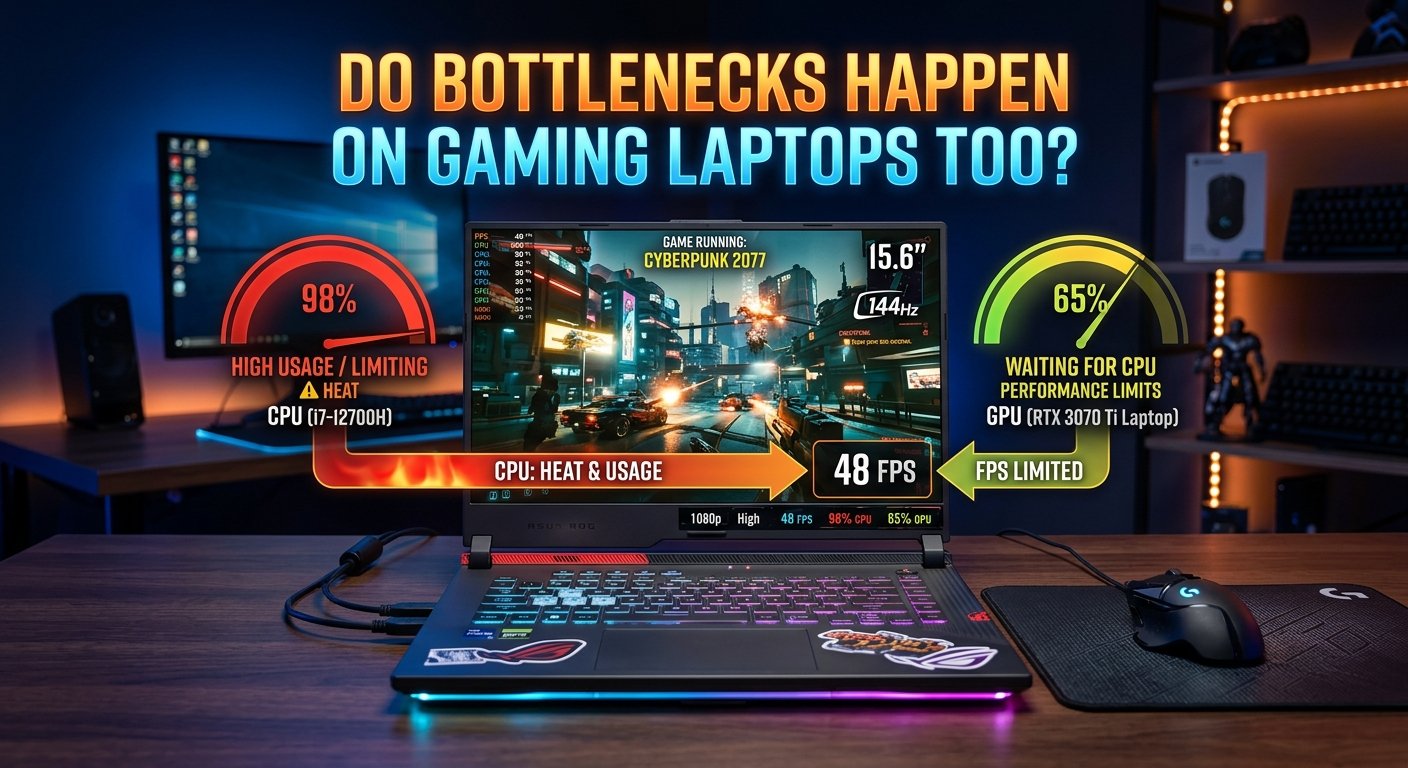
A CPU bottleneck occurs when your processor cannot generate and deliver frames quickly enough to keep your GPU continuously occupied. Think of it like a factory production line: your CPU prepares the 'work orders' (draw calls, game logic, physics), and your GPU carries them out. If the CPU is slow, the GPU sits waiting and its usage drops.
This is especially common in CPU-intensive titles like open-world games (GTA V, Cyberpunk 2077, Assassin's Creed), RTS games, and simulators. If your CPU usage is at 90–100% while your GPU is at 40–60%, you have a classic bottleneck. Solutions include upgrading your CPU, overclocking your processor, closing background applications, or playing at higher resolutions to shift more workload to the GPU.
- Top Reasons Your GPU Usage Drops During Gaming
- CPU Bottleneck The #1 Culprit
- GPU Thermal Throttling
- Outdated or Corrupt GPU Drivers
- Insufficient or Failing Power Supply
- In Game Settings Too Low
- Frame Rate Cap and V-Sync
- Background Processes & Software Interference
- Step by Step Fix Guide
- When to Worry vs. When It's Normal
- Conclusion
GPU Thermal Throttling
When a GPU gets too hot typically above 83 90°C depending on the model it automatically reduces its operating clock speed and power draw to prevent damage. This self-protection mechanism directly causes GPU usage to drop during intensive gaming sessions.
|
Watch out: If your GPU temps consistently exceed 85°C and you notice sudden drops in both GPU usage and FPS at the same time, thermal throttling is almost certainly the cause. |
Fix this by improving case airflow, replacing thermal paste on older cards, cleaning dust from heatsinks and fans, or setting a more aggressive fan curve in MSI Afterburner or your GPU's control software.
Outdated or Corrupt GPU Drivers
GPU drivers are the software layer between your operating system and graphics hardware. Outdated, incorrectly installed, or corrupt drivers frequently cause erratic GPU usage including random drops mid-game. This is especially true after Windows updates, which can sometimes conflict with existing driver installations.
The fix: use Display Driver Uninstaller (DDU) in Safe Mode to completely remove your current driver, then install the latest version from NVIDIA, AMD, or Intel's official website. Avoid generic Windows-installed drivers for gaming.
Insufficient or Failing Power Supply
High-end GPUs like the RTX 4080 or RX 7900 XTX can demand enormous power spikes under load. If your power supply unit (PSU) is undersized or aging, it may fail to deliver stable voltage during these peaks causing the GPU to throttle or drop usage to compensate.
Additionally, using daisy-chained PCIe power cables (two connectors on one cable run) can cause voltage sag on high-power cards. Always use separate cable runs from your PSU for each PCIe connector your GPU requires.
In Game Settings Too Low
This one surprises many people. If your graphics settings are set too low especially resolution or texture quality your GPU finishes rendering each frame so fast that it completes the frame budget with time to spare and enters an idle-like state until the next frame cycle. This shows up as 60–70% GPU usage even though the game looks like it should be demanding.
|
Pro Tip: Try enabling higher quality settings like ray tracing, SSAO, shadow quality, or render scale. If GPU usage jumps to 95%+ and FPS stays smooth, your GPU was simply under-challenged before. |
Frame Rate Cap and V-Sync
If your game has a frame rate cap enabled either in-game, via driver settings, or through V-Sync the GPU deliberately throttles itself once it hits that cap. For example, if V-Sync locks you at 60 FPS on a 60Hz monitor, the GPU will only work hard enough to maintain 60 FPS, leaving significant headroom. Disable or raise the frame rate cap, or enable G-Sync/FreeSync for adaptive sync without throttling.
Background Processes & Software Interference
Antivirus scans, Windows Update downloads, Discord video encoding, browser video playback, and other background tasks consume CPU cycles limiting how much frame data gets sent to the GPU. Some overlays (like GeForce Experience's in-game overlay or Xbox Game Bar) can also introduce CPU overhead that contributes to the bottleneck.
Audit your startup applications, disable unnecessary overlays, and ensure Game Mode is enabled in Windows Settings for better CPU resource allocation during gaming.
Step by Step Fix Guide
Monitor GPU temp, usage, CPU usage, and FPS simultaneously using MSI Afterburner + RivaTuner to identify the pattern of the drop.
Check for thermal throttling if GPU temps exceed 85°C during drops, prioritize cooling: clean fans, repaste, improve airflow.
Reinstall GPU drivers using DDU in Safe Mode, then install the latest version from the manufacturer's official site.
Verify PSU wattage is adequate for your GPU and use dedicated cable runs for PCIe power connectors.
Disable V-Sync and any FPS caps in-game; test with uncapped frames to see if GPU usage rises to 95%+.
Close all background apps before gaming especially browsers, Discord video, cloud sync, and antivirus scans.
If CPU is maxed out while GPU is under 70%, consider upgrading CPU, overclocking, or playing at 1440p/4K to shift load to GPU.
Enable Windows Game Mode and disable Game Bar overlay, GeForce Experience in-game overlay, and Xbox Game DVR.
When to Worry vs. When It's Normal
Not all GPU usage drops signal a problem. In less demanding game scenes a loading screen, a menu, or a simple outdoor area the GPU may legitimately have little to render, and usage naturally drops. What you should watch for is persistent low GPU usage during demanding scenes where you'd expect the card to be working hard.
If usage consistently stays below 70% in graphically intensive scenarios with frame rate well below your monitor's refresh rate, that's the signal to diagnose. If GPU usage is at 60% but you're getting a locked 165 FPS on a 165Hz monitor, your card is performing perfectly it just doesn't need to work harder.
Conclusion
|
A GPU usage drop during gaming is almost always a symptom, not the root cause. Whether it's a CPU bottleneck, thermal throttling, driver issues, or a frame rate cap artificially limiting performance each cause has a clear diagnosis path and a practical fix. Use monitoring tools like MSI Afterburner to observe your system in real time, isolate the pattern, and apply the targeted fix. With the right adjustments, you can get your GPU running at the high, stable utilization it was designed to maintain and enjoy the smooth, frame-perfect gaming experience your hardware is capable of delivering. |