How to Reduce Bottleneck in Games: The Complete Guide to Smoother, Faster Gaming
What Is a Bottleneck in Gaming?
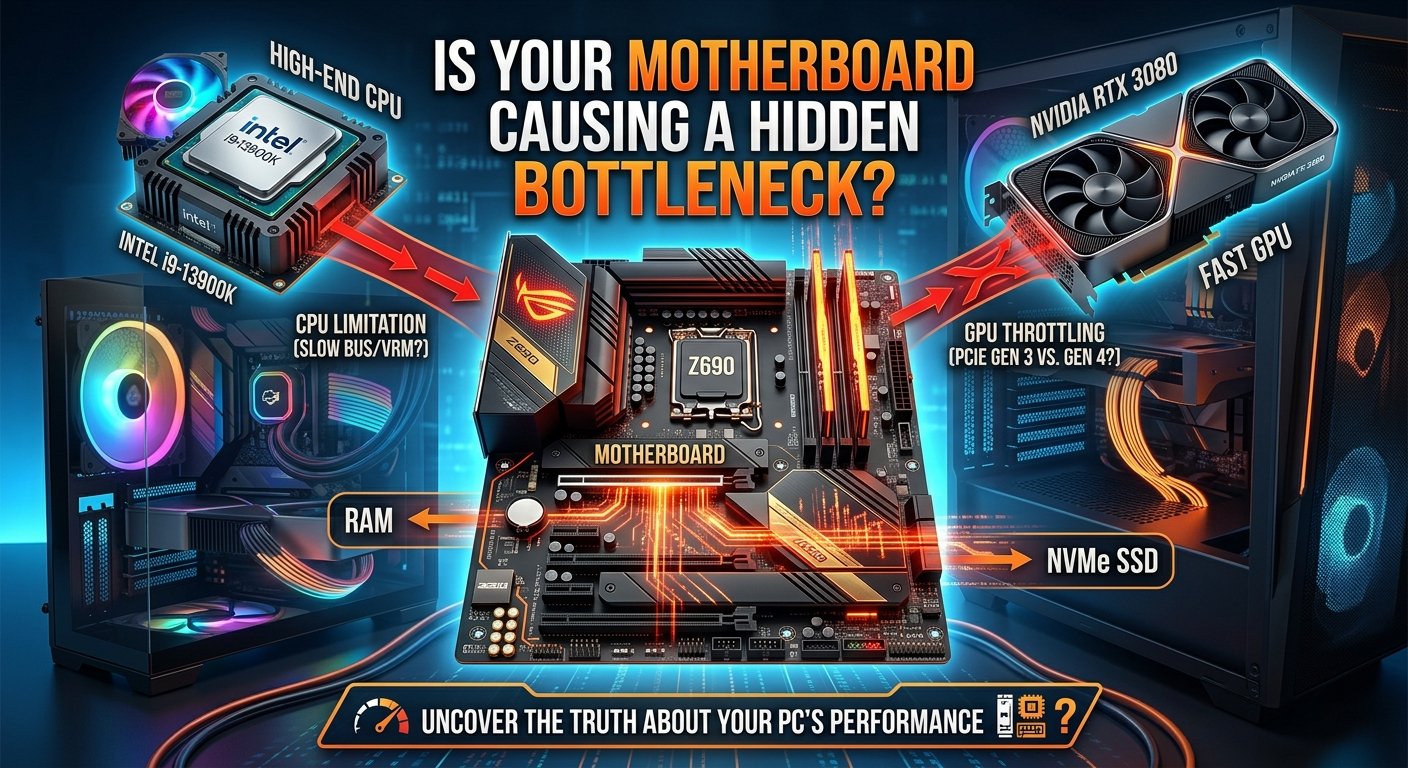
A bottleneck occurs when one component in your PC cannot keep up with the demands placed on it by another, forcing the rest of the system to slow down and wait. Think of it like a highway with five wide lanes suddenly narrowing to one traffic backs up regardless of how fast individual cars can travel.
In gaming, the most common bottlenecks happen between the CPU (Central Processing Unit) and GPU (Graphics Processing Unit). When your CPU cannot feed data to your GPU fast enough, your GPU sits underutilized. Conversely, when your GPU is the weak link, your CPU finishes its work and waits. Both scenarios result in lower frame rates, stuttering, and an overall degraded experience.
How to Identify a Bottleneck
Before fixing anything, you need to know what is actually being bottlenecked. The two best tools for this are MSI Afterburner with RivaTuner Statistics Server and Task Manager's Performance tab. Run a game at your normal settings, then check:
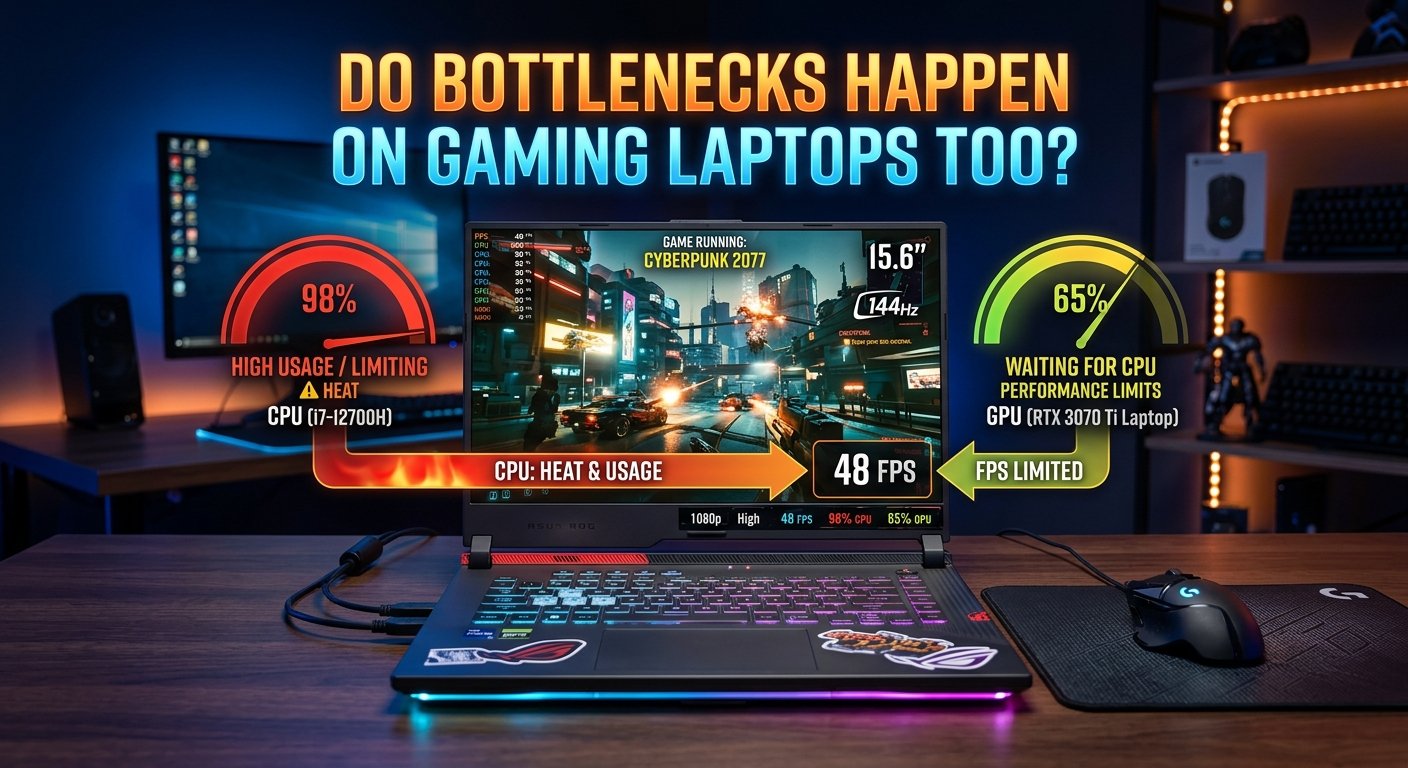
• If your GPU usage is consistently below 90% while CPU usage is near 100% ou have a CPU bottleneck.
• If your GPU usage is near 100% while your CPU stays comfortably below 70% ou have a GPU bottleneck.
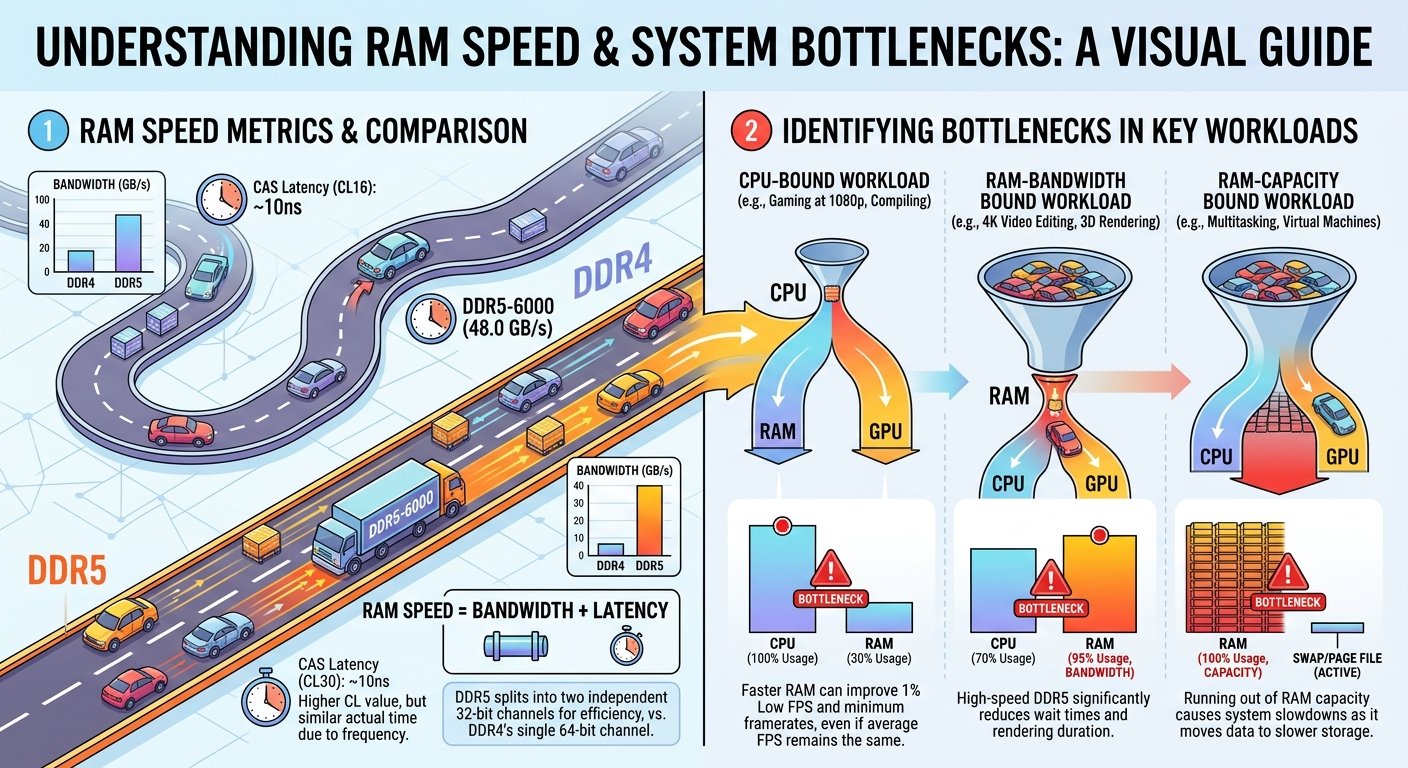
• If RAM usage is maxed out, insufficient memory could be the hidden culprit.
|
PRO TIP A GPU bottleneck at 90-99% usage is actually healthy — it means your graphics card is working to its full potential. A CPU bottleneck is where performance problems truly begin. |
Lower CPU Heavy Game Settings
If your CPU is the bottleneck, the first and most immediate fix is reducing settings that stress it. Many players mistakenly lower GPU settings (like texture quality) when the real culprit is CPU-bound tasks. Instead, focus on:
• NPC/crowd density: Open-world games like Cyberpunk 2077 or GTA V simulate thousands of characters. Reducing crowd density directly offloads CPU work.
• Simulation distance: Lowering how far the game simulates physics and AI reduces CPU overhead significantly.
• Disable or reduce draw distance: The CPU is responsible for culling, so shorter draw distances mean less work per frame.
Enable and Optimize XMP/EXPO for Your RAM
RAM speed is one of the most underappreciated contributors to gaming bottlenecks. Your CPU communicates with RAM thousands of times per second, and slow RAM creates a data pipeline that cannot keep up. Most gaming PCs ship with RAM running at its base JEDEC speed (often 2133 MHz or 2400 MHz) rather than its advertised XMP speed.
To fix this, enter your BIOS on startup (usually by pressing Delete or F2) and enable XMP (for Intel) or EXPO (for AMD). This single change can reduce CPU bottlenecks by 5-15% in CPU-limited titles, particularly in games that rely heavily on fast data streaming like competitive shooters.
|
IMPORTANT For AMD Ryzen CPUs, RAM running at 6000 MHz with a 1:1 memory controller ratio hits the sweet spot for performance. Going higher can actually reduce performance due to looser timings. |
Overclock Your CPU (Safely)
If you own an unlocked CPU (Intel K-series or any modern AMD Ryzen), overclocking is one of the most effective ways to reduce a CPU bottleneck without spending money. Running your CPU at higher clock speeds means it can process game logic, AI, and physics faster giving your GPU more to work with every second.
For AMD Ryzen CPUs, Precision Boost Overdrive (PBO) combined with Curve Optimizer offers an easy, motherboard-guided path to safe performance gains. For Intel CPUs, tools like Intel XTU (Extreme Tuning Utility) provide a user-friendly interface for raising power limits and per-core frequencies. Always monitor temperatures and stay below 90 degrees Celsius under sustained load.
Upgrade to Faster Storage
Modern open-world games stream enormous amounts of data from your drive in real time. If you are running games from a traditional hard disk drive (HDD), you are creating a storage bottleneck that causes texture pop-in, long loading screens, and even mid-game stutters as the CPU waits for data that has not loaded yet.
Moving your games to an NVMe SSD (PCIe 3.0 or 4.0) eliminates this bottleneck almost entirely. Technologies like DirectStorage, supported in Windows 11 and DirectX 12 Ultimate games, allow the GPU to pull assets directly from the NVMe drive, bypassing the CPU entirely. This is a hardware upgrade with one of the most noticeable real-world impacts in modern gaming.
Adjust In Game Resolution and Rendering Scale
One of the most powerful tools to shift the bottleneck from the CPU to the GPU or vice versa is resolution scaling. When you increase resolution (for example, from 1080p to 1440p or 4K), you push more work onto the GPU and less relative pressure on the CPU. This can actually resolve a CPU bottleneck by giving the GPU more to do, balancing the workload.
Conversely, tools like NVIDIA DLSS, AMD FSR, and Intel XeSS allow your GPU to render at a lower internal resolution and upscale to your display resolution using AI or spatial algorithms. At DLSS Quality mode, for instance, you can gain 20-40% more FPS while maintaining near-native image quality — effectively giving your GPU headroom and reducing the total rendering burden.
Monitor and Manage Background Processes
A CPU handling a game simultaneously juggling Discord, a browser with 20 tabs, antivirus scans, and Windows Update is a CPU being throttled before it even starts. Reducing background process load is free and immediate.
• Use Task Manager to end non-essential processes before gaming.
• Disable startup programs via Task Manager > Startup tab.
• Set your game's process priority to 'High' in Task Manager for more CPU scheduling priority.
• Ensure your GPU drivers are up to date outdated drivers can cause unnecessary CPU overhead in API calls.
Consider a Hardware Upgrade
When all software optimizations are exhausted, hardware is the final answer. If your CPU is more than three generations behind your GPU, a targeted upgrade makes the most economic sense. Pairing a high-end GPU like an RTX 4080 with a six-year-old quad-core processor is one of the most common bottleneck scenarios in gaming PCs today.
Before upgrading, use an online bottleneck calculator to model your specific CPU/GPU pairing at your target resolution. At 1080p, CPU bottlenecks are most severe. At 4K, the GPU becomes the dominant workload, making CPU choice less critical. Choosing the right resolution for your hardware balance is itself a form of bottleneck management.
Final Thoughts
Reducing a bottleneck in gaming is less about chasing the most expensive hardware and more about understanding the balance between your components. Start by diagnosing with monitoring tools, apply software fixes first (XMP, overclocking, background management, DLSS), and pursue hardware upgrades only when you have maximized what your current system can do. A well-balanced, well-tuned system will always outperform an unbalanced one no matter how expensive the individual parts.