How to Check If Your PC Has a Bottleneck
How to Check If Your PC Has a Bottleneck
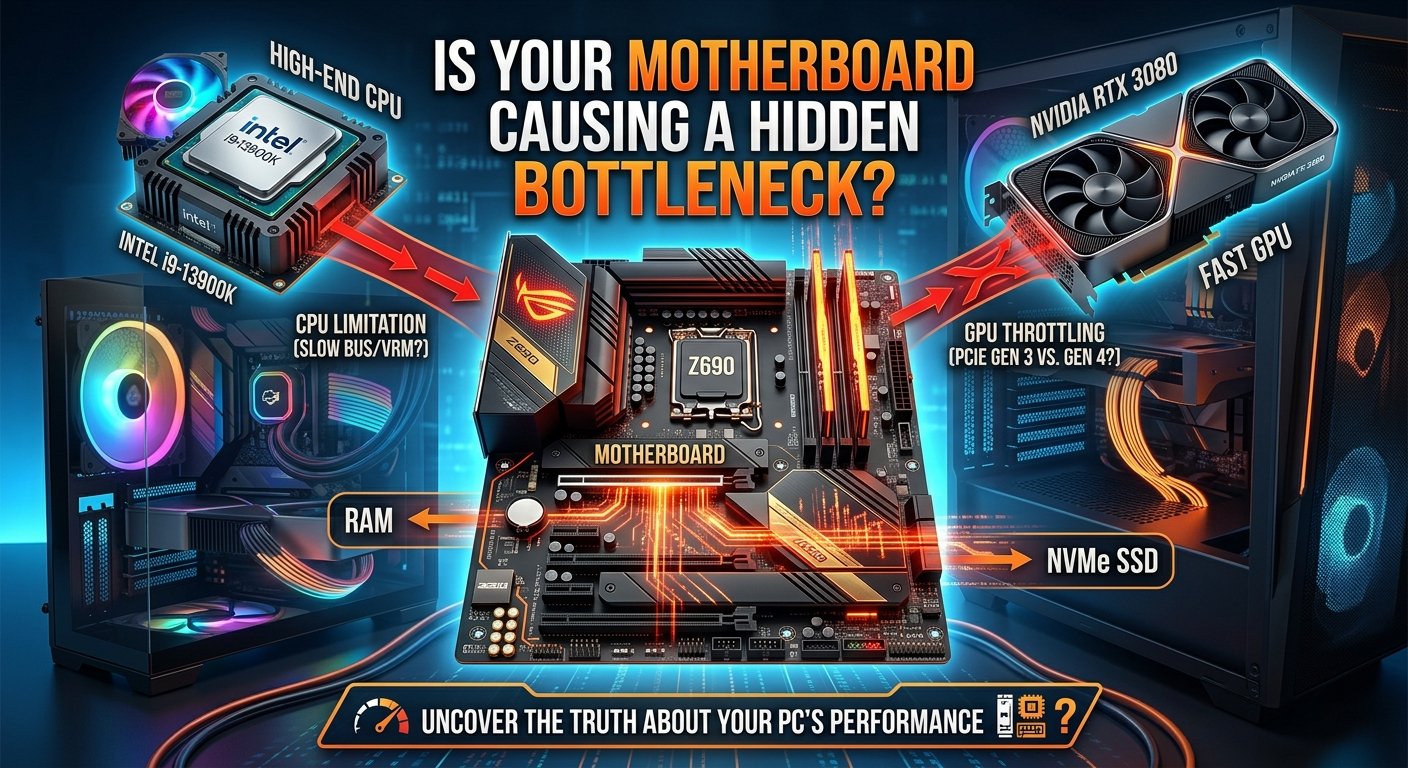
You've spent good money on your gaming rig, but something feels off. Frame rates drop unexpectedly, your GPU usage looks low while your CPU is maxed out, or your new graphics card isn't performing like the benchmarks promise. Chances are, your PC has a bottleneck and if you don't know how to check if your PC has a bottleneck, you're flying blind when it comes to upgrades.
This guide walks you through everything: what a bottleneck is, how to diagnose one, practical real-world examples, gaming-specific tips, and how to use a bottleneck calculator to make smarter hardware decisions.
What Is a PC Bottleneck?
A bottleneck occurs when one component in your system cannot keep up with another, limiting overall PC performance. Think of it like water flowing through a pipe if one section is narrower than the rest, it restricts total flow regardless of how wide everything else is.
In PC terms, the most common bottleneck is between the CPU (processor) and the GPU (graphics card). If your CPU cannot feed data to your GPU fast enough, your GPU sits idle waiting and you lose frames. A bottleneck doesn't always mean your hardware is bad; it often means your components are simply mismatched.
How to Check If Your PC Has a Bottleneck
Monitor CPU and GPU Usage in Real Time
Follow these steps to diagnose a bottleneck:
Enable GPU Usage and CPU Usage in the monitoring settings. Also enable FPS for context.
- What Is a PC Bottleneck?
- How to Check If Your PC Has a Bottleneck
- Monitor CPU and GPU Usage in Real Time
- Use an Online Bottleneck Calculator
- Practical Bottleneck Examples
- Budget Build: Ryzen 5 3600 + RX 6800 XT @ 1080p
- Mid-Range Sweet Spot: Core i5-13600K + RTX 4070 @ 1440p
- Gaming-Specific Bottleneck Tips
- What to Do Once You Find a Bottleneck
- Conclusion
Launch a demanding game at your target settings and play for 10-15 minutes in a demanding scene.
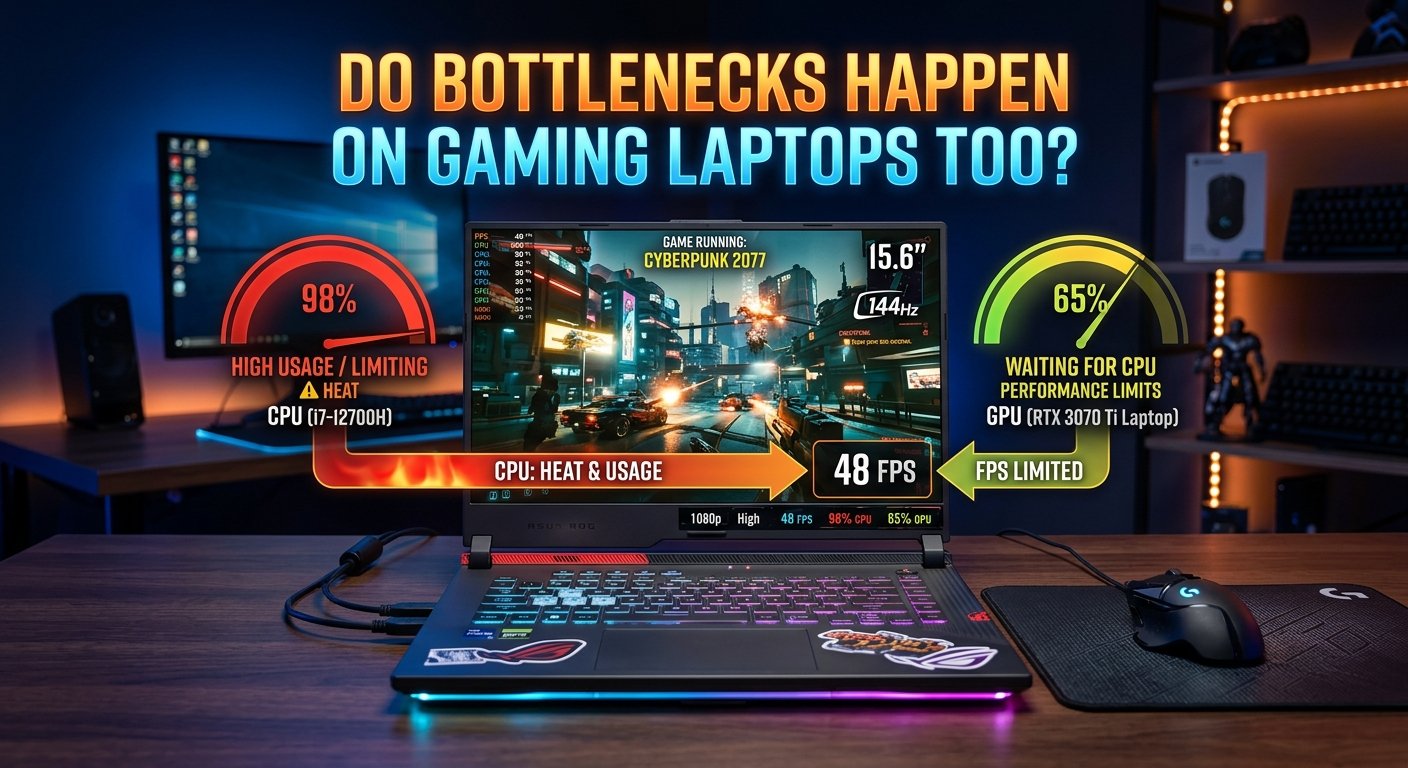
Watch the numbers: If GPU usage is below 90-95% while CPU is at 100%, your CPU is the bottleneck. If GPU is at 99% and CPU is relaxed, that's actually the ideal scenario.
•Note your frame times stuttering with average-looking FPS often points to a CPU bottleneck causing inconsistent frame delivery.
Use an Online Bottleneck Calculator
A bottleneck calculator lets you enter your CPU and GPU models, select your target resolution, and instantly see a bottleneck percentage with a compatibility rating. It draws from thousands of benchmark comparisons to give you a data-backed answer in seconds no downloads required.
Practical Bottleneck Examples
Budget Build: Ryzen 5 3600 + RX 6800 XT @ 1080p
CPU Usage: 98-100% (Bottlenecked) | GPU Usage: 65-75% (Underutilized)
At 1080p, a Ryzen 5 3600 cannot feed data to an RX 6800 XT fast enough. The fix? Either upgrade to a Ryzen 5 5600X or 7600, or switch to 1440p gaming where the GPU does more work per frame, easing CPU load.
Mid-Range Sweet Spot: Core i5-13600K + RTX 4070 @ 1440p
CPU Usage: 55-70% (Healthy) | GPU Usage: 93-99% (Optimal)
This is the ideal scenario. The GPU is the limiting factor (as it should be), the CPU has headroom, and you're extracting nearly every frame your system can deliver. A bottleneck calculator gives this combo a high compatibility score at 1440p.
Gaming-Specific Bottleneck Tips
Resolution Matters: A CPU bottleneck at 1080p often disappears at 1440p or 4K because the GPU has to work harder per frame. Before buying new hardware, try bumping your resolution first.
Game Engine Matters: CPU-heavy games like Microsoft Flight Simulator and Cities: Skylines 2 will bottleneck almost any GPU. GPU-limited games like Cyberpunk 2077 at max settings are the opposite. Match your expectations to the game genre.
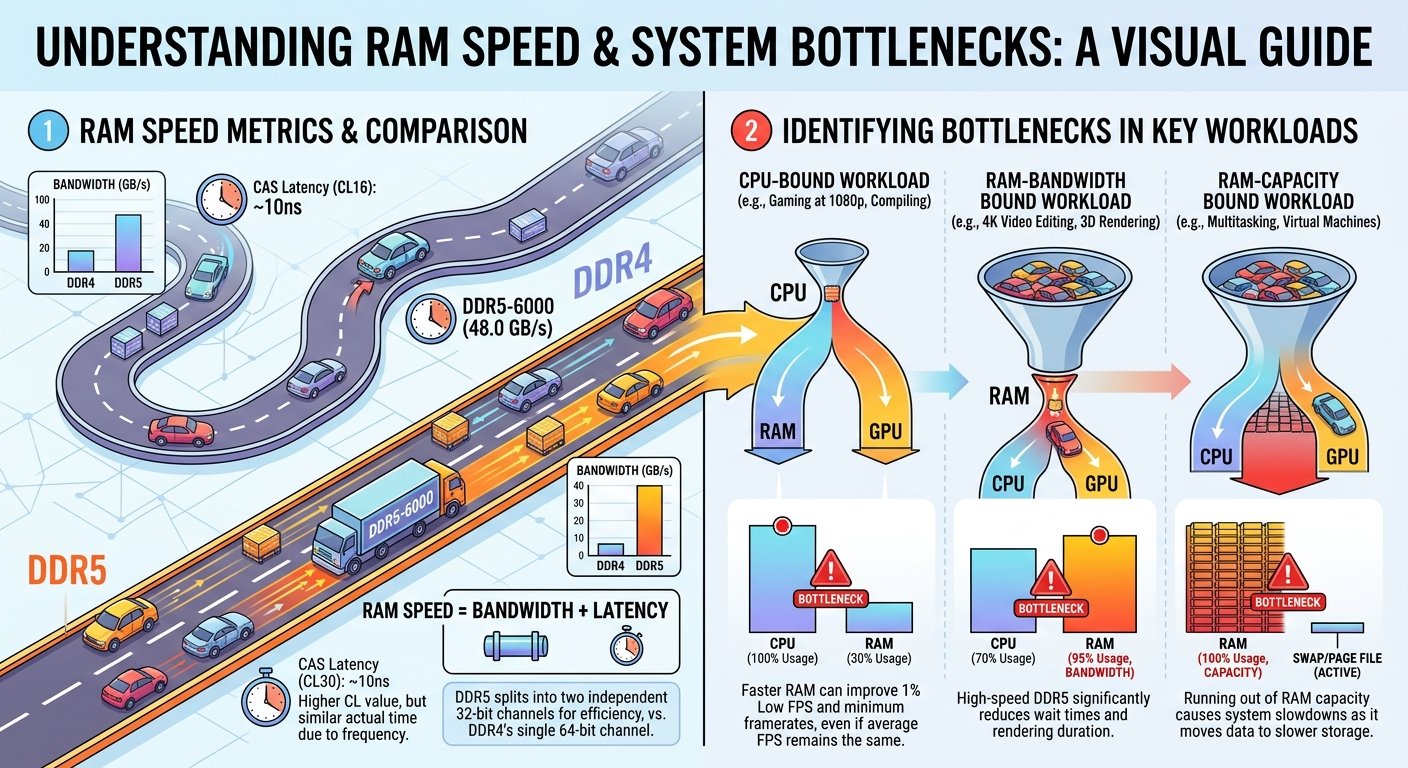
RAM Speed Affects CPU Bottlenecks: AMD Ryzen CPUs are sensitive to RAM speed. Upgrading from DDR4-2133 to DDR4-3600 can reduce CPU bottlenecking by 5-10% in some games essentially a free performance boost.
Enable DLSS, FSR, or XeSS: AI upscaling technologies offload render resolution from your GPU, often eliminating GPU limitations. If you're GPU-bottlenecked, these tools are your best friends.
What to Do Once You Find a Bottleneck
If your CPU is the bottleneck: Try overclocking (if supported), enable XMP/EXPO for RAM, and close background apps. If that doesn't help, target a same-platform CPU upgrade before swapping your GPU.
If your GPU is the bottleneck: This is actually ideal your CPU is not holding you back. Reduce graphical settings for more frames, or upgrade your GPU when budget allows.
If both are near 100%: You may be in a perfectly balanced scenario or your system is aging together. Use a bottleneck calculator to simulate what a single upgrade would do before spending money.
Conclusion
Knowing how to check if your PC has a bottleneck is one of the most valuable skills for any PC gamer or builder. Instead of blindly upgrading expensive components, you can pinpoint exactly what's holding your system back and make targeted, cost-effective decisions.
Use real-time monitoring with MSI Afterburner, cross-check with our free bottleneck calculator, and apply the gaming tips in this guide. Your next upgrade will be smarter, cheaper, and actually impactful.