CPU vs GPU Bottleneck: Which Is Worse for Your Gaming PC?
CPU vs GPU Bottleneck: Which Is Worse for Your Gaming PC?
Your game is stuttering, your frames are dropping, and you don't know why. Before you spend money on an upgrade, you need to know: is your CPU or GPU the weakest link and which bottleneck actually hurts more? This guide breaks it all down with practical examples and gaming tips.
What Is a PC Bottleneck?
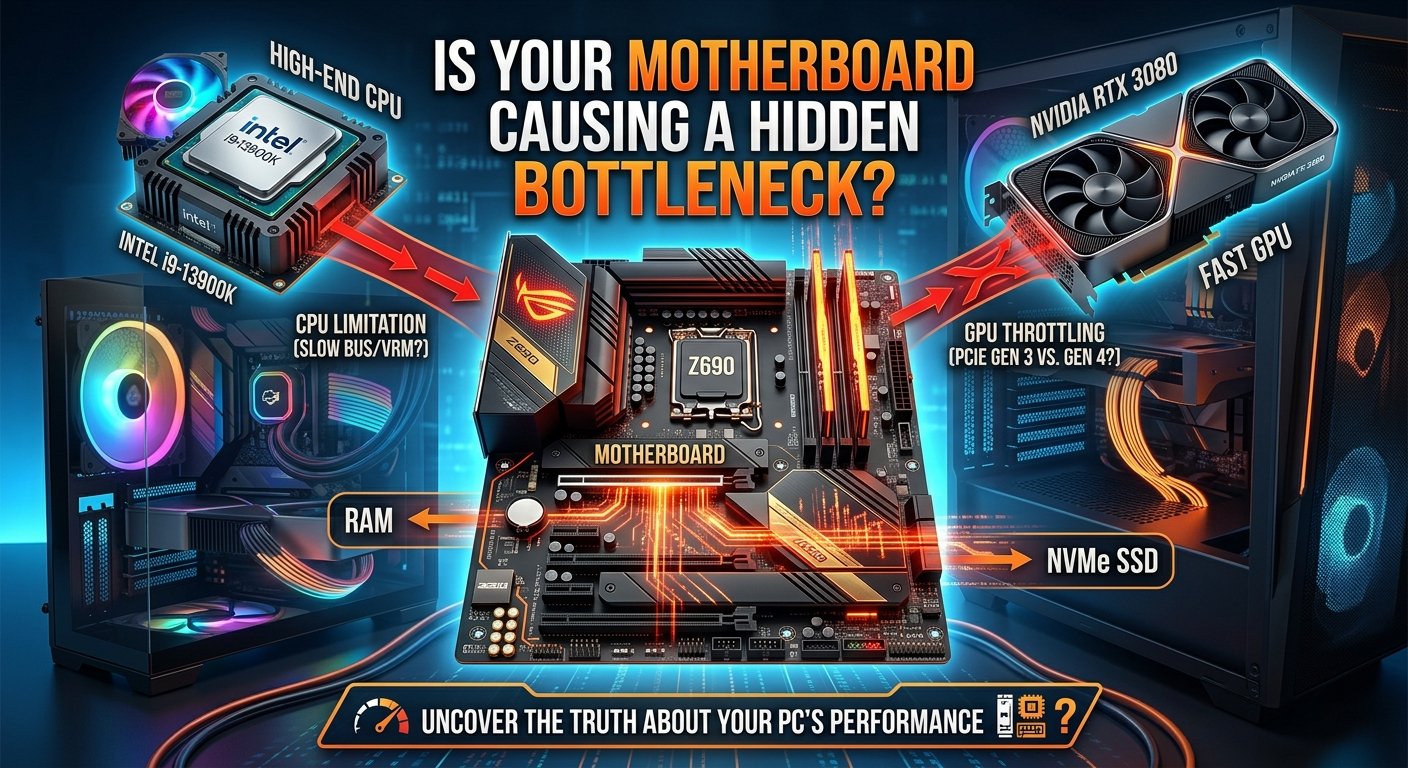
A bottleneck occurs when one component in your system is significantly slower than the others, limiting overall performance. In gaming PCs, the two most common culprits are the CPU (Central Processing Unit) and GPU (Graphics Processing Unit). Think of it like a highway: even if one lane is wide open, a narrow section upstream forces all traffic to slow down.
When people debate CPU vs GPU bottleneck which is worse, the answer isn't always straightforward. Both can tank your gaming experience, but in very different ways. A bottleneck percentage above 10-15% means your hardware is being held back. Use our free bottleneck calculator to get your exact number in seconds.
What Is a CPU Bottleneck?
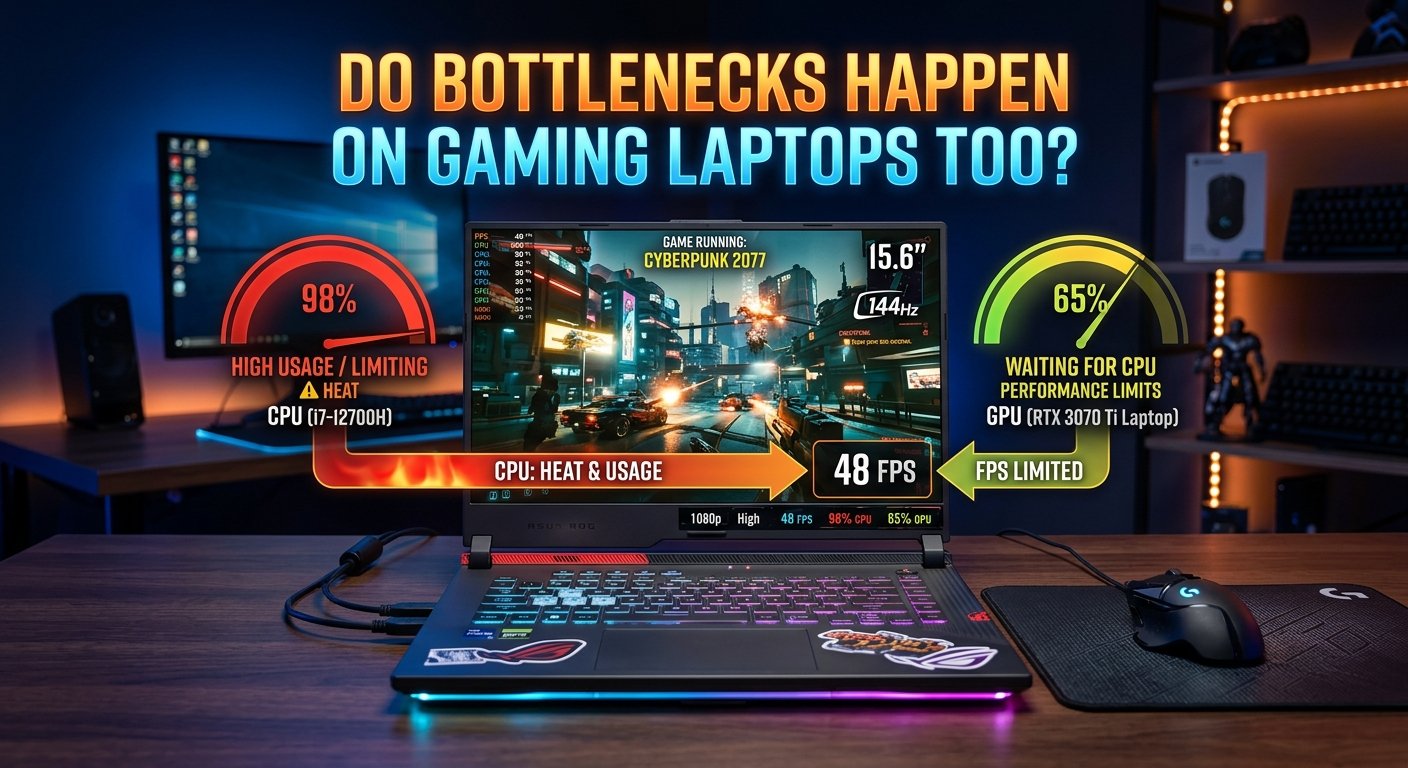
A CPU bottleneck happens when your processor can't feed data to the GPU fast enough. The GPU sits idle, waiting for instructions and your frame rates suffer. This is sometimes called being "CPU-bound."
Signs your CPU is bottlenecking your GPU:
CPU usage sits at 90-100% while GPU usage is below 70
- What Is a PC Bottleneck?
- What Is a CPU Bottleneck?
- Signs your CPU is bottlenecking your GPU:
- What Is a GPU Bottleneck?
- Signs your GPU is bottlenecking your CPU:
- CPU vs GPU Bottleneck: Which Is Worse?
- Gaming Tips: How to Reduce Your Bottleneck Right Now
- If you are CPU-bottlenecked:
- If you are GPU-bottlenecked:
- The 70% GPU Usage Rule Explained
- Final Verdict
Frame rate doesn't improve much when you lower graphics settings
Performance drops sharply in CPU-heavy scenarios (large crowds, open-world games)
Consistent stutters and frame time spikes during complex scenes
Practical Example: Pairing an aging Intel Core i5-7400 with a modern RTX 4070. In a game like Cyberpunk 2077, your GPU can push 120+ FPS but the old quad-core CPU can only manage ~60 FPS worth of game logic so you're capped at 60 FPS no matter what resolution you use.
What Is a GPU Bottleneck?
A GPU bottleneck the far more common scenario occurs when your graphics card is the system's limiting factor. Your CPU is ready and waiting, but the GPU can't render frames fast enough. You're "GPU-bound."
Signs your GPU is bottlenecking your CPU:
GPU usage is consistently at 98-100% while CPU is below 60%
Frame rate climbs noticeably when you lower resolution or graphics quality
High-resolution gaming (1440p, 4K) causes major slowdowns
Stable performance in open areas, drops in visually dense areas
Practical Example: Running a powerful Ryzen 7 7800X3D with a budget GTX 1650 at 1440p Ultra settings in Baldur's Gate 3 will leave your CPU mostly idle while the GTX 1650 struggles to hit 30 FPS. Dropping to 1080p Medium settings would immediately double your frame rate.
CPU vs GPU Bottleneck: Which Is Worse?
|
CPU Bottleneck |
GPU Bottleneck |
|
Harder to work around in-game |
Easier to manage with settings |
|
Lowering settings rarely helps |
Resolution and quality drops help immediately |
|
Causes microstutters — feels worse than low FPS |
Smoother experience at lower settings |
|
Affects all resolutions equally |
Mainly a problem at higher resolutions |
|
More disruptive in competitive titles |
DLSS/FSR can bridge the gap |
Verdict: In most gaming scenarios, a CPU bottleneck is worse. It causes unpredictable stutters that no in-game setting can fix. A GPU bottleneck, while limiting, is more manageable you have direct control through resolution scaling, quality presets, and AI upscaling tech like DLSS 3 and FSR 3.
Gaming Tips: How to Reduce Your Bottleneck Right Now
If you are CPU-bottlenecked:
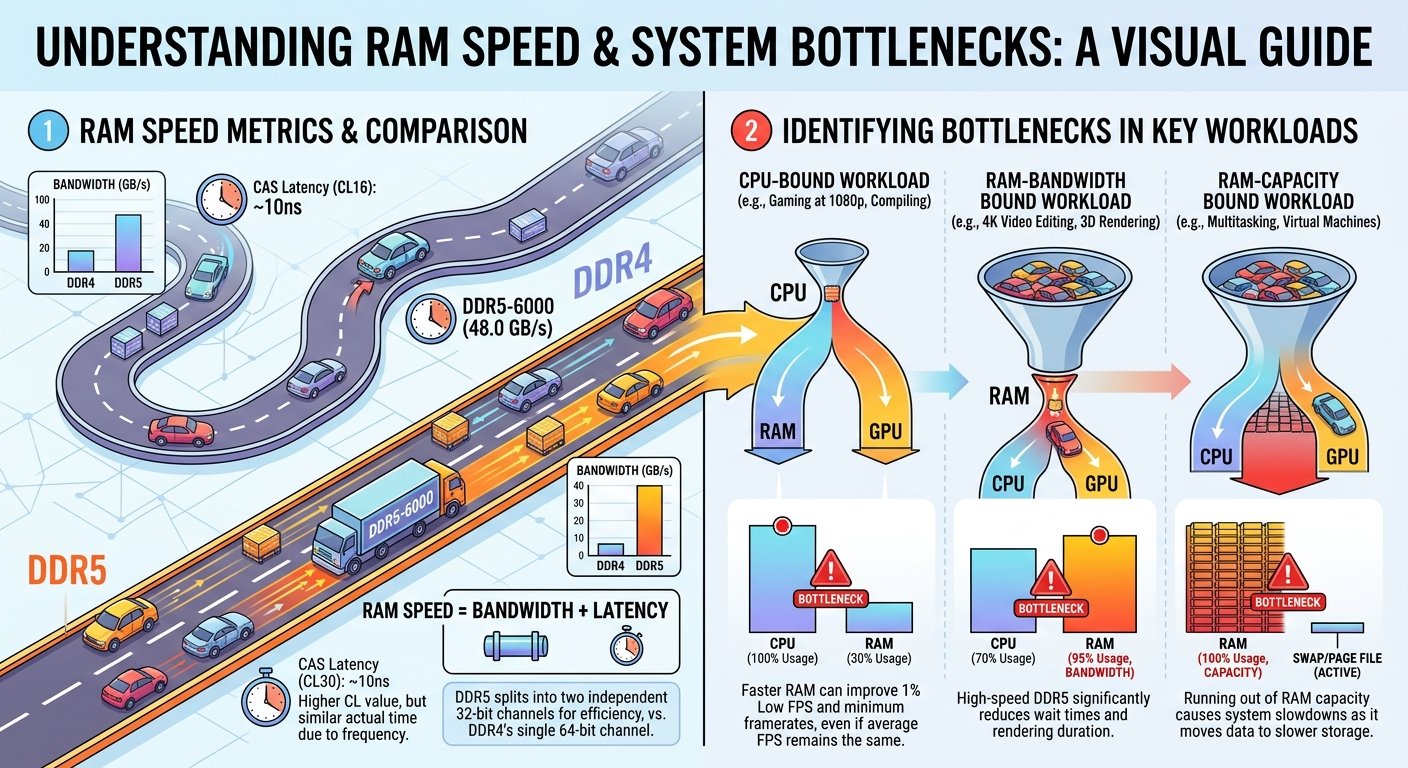
Enable XMP/EXPO in BIOS faster RAM dramatically reduces CPU bottlenecks. A 3200 MHz kit often boosts FPS by 10-20% in CPU-limited games.
Close background apps Discord, Chrome tabs, and OBS all eat CPU cores. Close them before launching a game session.
Raise your resolution or graphics settings counterintuitively, this shifts load to your GPU and reduces CPU pressure.
Use frame generation (DLSS 3 / FSR 3) generates extra frames with GPU compute, bypassing the CPU's frame rate ceiling.
If you are GPU-bottlenecked:
Enable DLSS, FSR, or XeSS render at a lower resolution internally and upscale. Quality difference is nearly invisible at 1440p+.
Lower shadow quality and ray tracing these are the most GPU-intensive settings and provide the smallest visual benefit at lower levels.
Reduce your resolution temporarily dropping from 1440p to 1080p can add 40-60% more frames in GPU-limited scenarios.
Overclock your GPU (with caution) even a modest 10% overclock can push you over the 60 or 144 FPS threshold you're targeting.
The 70% GPU Usage Rule Explained
You may have heard that "70% GPU usage means your CPU is bottlenecking you." This is partially true — but context matters enormously. The real signal to watch: monitor both CPU and GPU usage simultaneously using tools like MSI Afterburner with RivaTuner. If your CPU is pegged at 100% while the GPU idles below 70%, that's a definitive CPU bottleneck. If the GPU is pinned at 99% with the CPU below 60%, you're GPU-bound.
Final Verdict
When it comes to CPU vs GPU bottleneck — which is worse the CPU bottleneck typically causes the more damaging gaming experience because it produces stutters and frame time inconsistency that no setting can easily fix. A GPU bottleneck, while still performance-limiting, gives you more tools to work around it through resolution scaling, upscaling technology, and graphics settings.
The best approach is always to aim for a balanced build, use our bottleneck calculator to identify your weak link, and apply the targeted tips from this guide before committing to any hardware purchase. A smart software optimization can often recover 20-30% of lost performance — for free.