Percentage Calculator
Calculate percentages in multiple modes!
Description
A percentage calculator is a powerful mathematical tool that helps you find what portion one number represents out of another. Whether you are figuring out a discount at a store or working out your exam score or trying to understand how much your salary has grown over the past year a percentage calculator makes the entire process fast and completely free of error. This guide walks you through everything related to the percentage calculator including what it is how it works the formulas behind it real world scenarios where it saves time and the most common questions people ask when they first start using one.
What Is a Percentage Calculator and Why Does It Matter
At its most basic level a percentage calculator is any tool or method that lets you express one number as a fraction of one hundred. The word percent itself comes from the Latin phrase per centum which simply means out of one hundred. Students will also find our GPA Calculator useful calculate your cumulative GPA in seconds.So when someone says that a product is thirty percent off they are saying that for every one hundred units of price you are saving thirty of those units.
This concept sounds straightforward but in real daily life percentages pop up in situations that can get surprisingly complicated. You might need to know what percentage of your income goes toward rent or what percentage increase your electricity bill saw compared to last month or how to calculate the percentage difference between two product prices before making a purchase decision. A dedicated percentage calculator removes all the guesswork and mental arithmetic from these tasks.
Beyond personal finance percentages are the language of business science healthcare education and government reporting. Unemployment rates are percentages. Your blood oxygen level is a percentage. Your student loan interest is a percentage. The growth rate of a company's revenue is a percentage. Learning how to use a percentage calculator means learning how to read and interact with a massive portion of the information that shapes our world.
The Core Formulas Behind Every Percentage Calculation
Every percentage calculator no matter how simple or advanced operates on a handful of core mathematical relationships. Understanding these relationships means you will never feel lost when a percentage problem shows up in an unexpected context.
Finding What Percent One Number Is of Another
This is the most common type of percentage question. You have two numbers and you want to know how the smaller one relates to the larger one as a percentage.
Formula Percentage (Part divided by Whole) multiplied by 100
Imagine you scored 74 points out of a possible 92 points on a test. You divide 74 by 92 and then multiply that result by 100. The answer is approximately 80.43 percent. A percentage calculator gives you this instantly without any chance of a rounding mistake on your end.
Finding the Percentage of a Number
This version asks a different question. Instead of finding what percent a part represents you are asking what a given percent of a total actually equals in concrete terms.
Formula Result (Percentage divided by 100) multiplied by Total Number
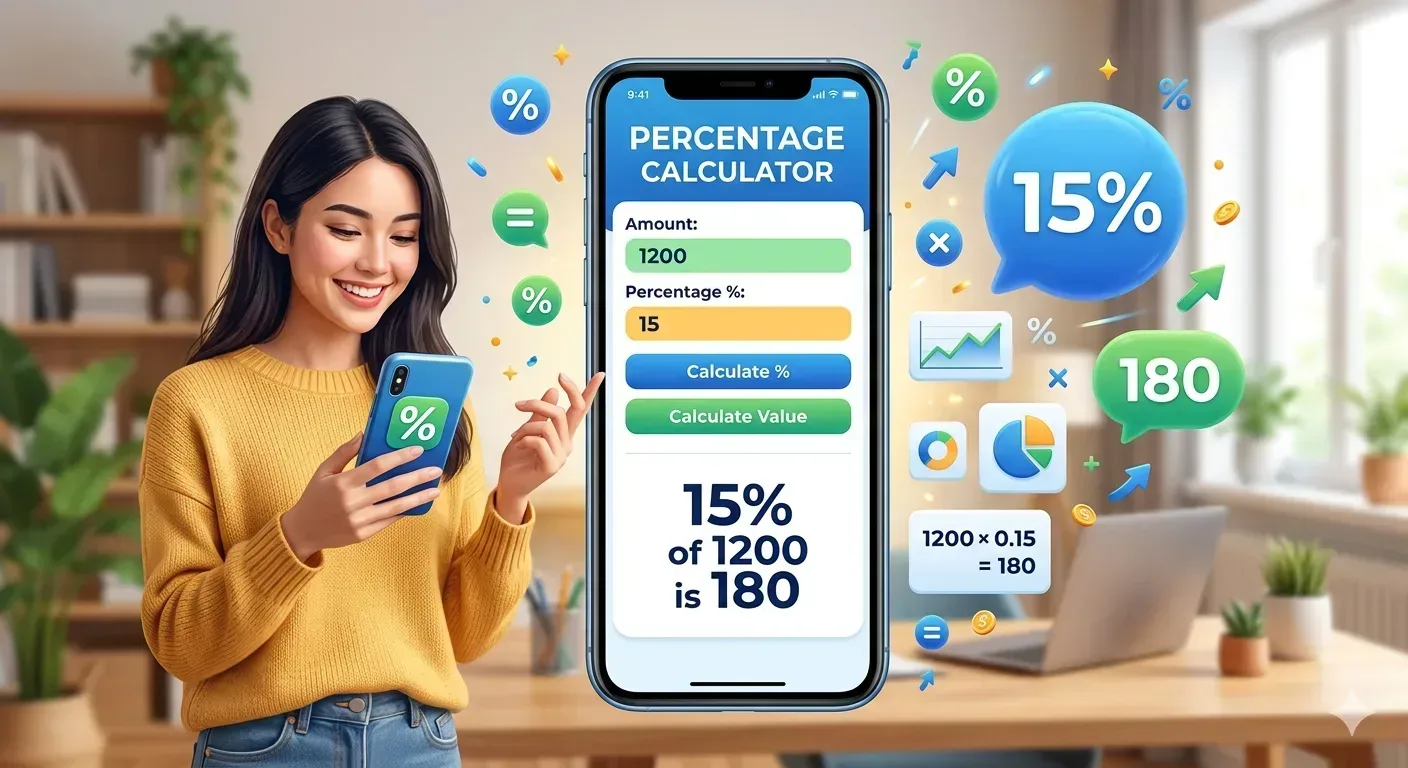
Say a jacket originally costs 240 dollars and it is on sale at 35 percent off. You want to know exactly how many dollars you are saving. You divide 35 by 100 and multiply that by 240. The answer is 84 dollars saved.
Finding the Original Whole When You Know the Part and the Percent
You know what a certain percentage equals in real terms and you need to work backwards to figure out the original total.
Formula Whole Part divided by (Percentage divided by 100)
Suppose you know that 18 percent of a company's staff equals 27 employees and you need to figure out the total headcount. You divide 27 by 0.18 and the answer is 150 employees.
Calculating Percentage Change
Percentage change tells you how much something has grown or shrunk relative to where it started. For financial planning, use our Loan Calculator to work out interest percentages on any loan. This is the formula behind every news headline about inflation and stock market movement and population growth.
Formula Percentage Change ((New Value minus Old Value) divided by Old Value) multiplied by 100
If a house was worth 180000 dollars three years ago and is worth 231000 dollars today the percentage change is approximately 28.33 percent increase. A positive result means growth and a negative result means a decline.
Real World Applications of the Percentage Calculator
The percentage calculator is one of those tools that you think you only need occasionally until you realize how many everyday decisions quietly involve a percentage somewhere in the background. Below are some of the most common and important real world scenarios where people reach for a percentage calculator.
Shopping and Discounts Instantly figure out sale prices tip amounts and loyalty reward calculations before reaching the checkout counte
Business and Finance Measure profit margins revenue growth tax rates return on investment and budget allocation with accuracy.
Academic Grading Convert raw scores into percentages track grade progress and calculate weighted averages across subjects
Health and Nutrition Calculate daily value percentages on nutrition labels body fat percentages and medication dosage ratios.
Real Estate Work out down payment percentages mortgage interest calculations and property appreciation rates over time.
Investing Track portfolio performance calculate compound growth and understand dividend yield as a percentage of price.For age based percentage calculations, our Age Calculator provides exact years and months.
Percentage Calculators in the Classroom
Students at every level from middle school through university encounter percentage problems constantly. A percentage calculator does not just give them the answer it helps them verify their own manual work and builds confidence in their understanding of the underlying logic. Teachers also use percentage calculators to grade assignments fairly especially when working with weighted grading systems where different assignments carry different levels of importance toward the final score.
Percentage Calculators in Business Decision Making
Every business owner needs to understand percentages at a deep level to make sound financial decisions. Gross profit margin is a percentage. Employee turnover rate is a percentage. Market share is a percentage. Customer retention rate is a percentage. Without a reliable way to calculate these figures quickly business owners are operating with incomplete information. A percentage calculator removes that uncertainty and makes every financial conversation sharper and more precise.
Percentage vs Percentage Point
One of the most common sources of confusion when working with a percentage calculator is the difference between a percentage change and a percentage point change. These two things sound similar but they measure entirely different things and mixing them up can lead to seriously flawed conclusions.
Imagine an interest rate rises from 4 percent to 6 percent. In percentage point terms that is a 2 percentage point increase because the actual number went up by 2. But in percentage terms the rate increased by 50 percent because 6 is 50 percent higher than 4. Both statements are technically accurate but they communicate very different things about the magnitude of the change.Aiming for Canadian immigration? CRS score is calculated as a percentage check yours with our CRS Calculator."
Politicians and marketers sometimes exploit this distinction by choosing whichever framing makes their case sound more or less dramatic. A percentage calculator used correctly helps you cut through that kind of selective framing by showing both the raw difference and the percentage change side by side.
Smart Tips for Getting the Most Out of Your Percentage Calculator
Even though a percentage calculator is easy to use there are a few strategies that help you get faster and more accurate results every time.
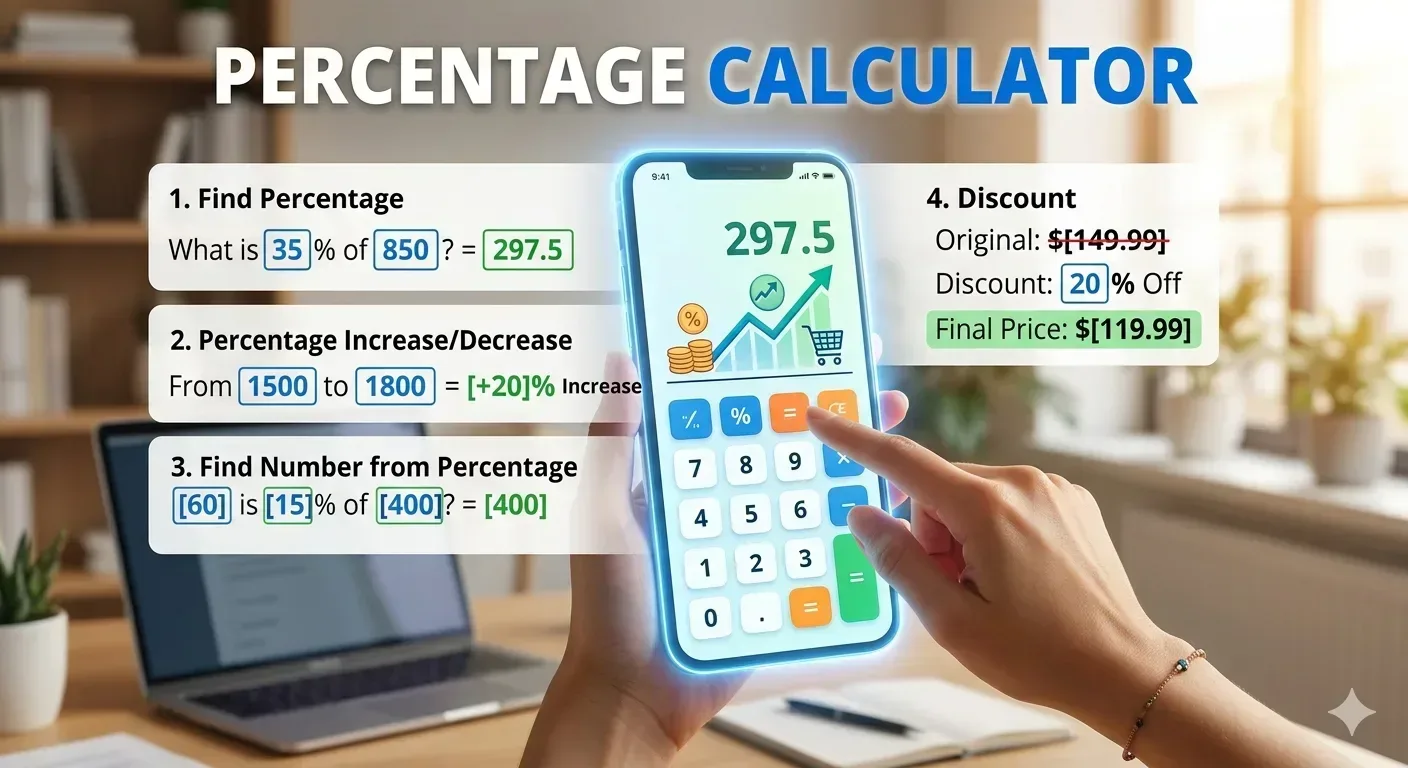
Always identify what type of problem you have first. Before entering any numbers pause and ask yourself whether you are finding a percent of a number or finding what percent one number is of another or calculating a change between two values.
Double check your base value. The base or whole in a percentage calculation matters enormously. Always confirm which number is the reference point before calculating.
Pay attention to rounding. In most everyday contexts you can round to two decimal places. But in financial or scientific contexts rounding prematurely can compound into significant errors.
Use percentage change rather than raw difference when comparing growth. Percentage change puts growth in context by anchoring it to where you started.
Understand that percentage can exceed one hundred. Percentage change can easily exceed one hundred percent if something more than doubles and percentage markup in retail frequently exceeds one hundred percent as well.
Verify your inputs are in the same units. If you are calculating what percentage of a year you spend at work make sure both numbers are in the same unit before dividing.
Types of Percentage Calculators You Will Find Online
Not all percentage calculators are built the same way. Understanding the different types helps you find exactly the right tool for any given situation.
General Percentage Calculator
This is the all purpose version that most people use. It typically lets you solve the three main types of percentage problems and is free fast and available on virtually every major math and finance website.
Tip Calculator
A tip calculator is a specialized percentage calculator designed for restaurant and service industry situations. You enter the total bill and select a tip percentage and the tool tells you both the tip amount and the new total.
Discount Calculator
Retail shoppers frequently use discount calculators which take an original price and a discount percentage and return the final price after the discount is applied. Learn how percentage calculations work in real life in our Percentage Calculator Complete Guide.More advanced versions also handle stacked discounts where multiple percentage reductions are applied one after another.
Grade or Score Percentage Calculator
These tools are designed specifically for academic contexts. You enter the number of points earned and the number of points possible and the calculator returns your score as a percentage and often a letter grade.
VAT and Tax Percentage Calculator
Tax calculators apply a percentage based tax rate to a pre tax amount to show the final total including taxes. They are also used in reverse to extract the pre tax amount from a tax inclusive price.
Common Mistakes People Make When Calculating Percentages
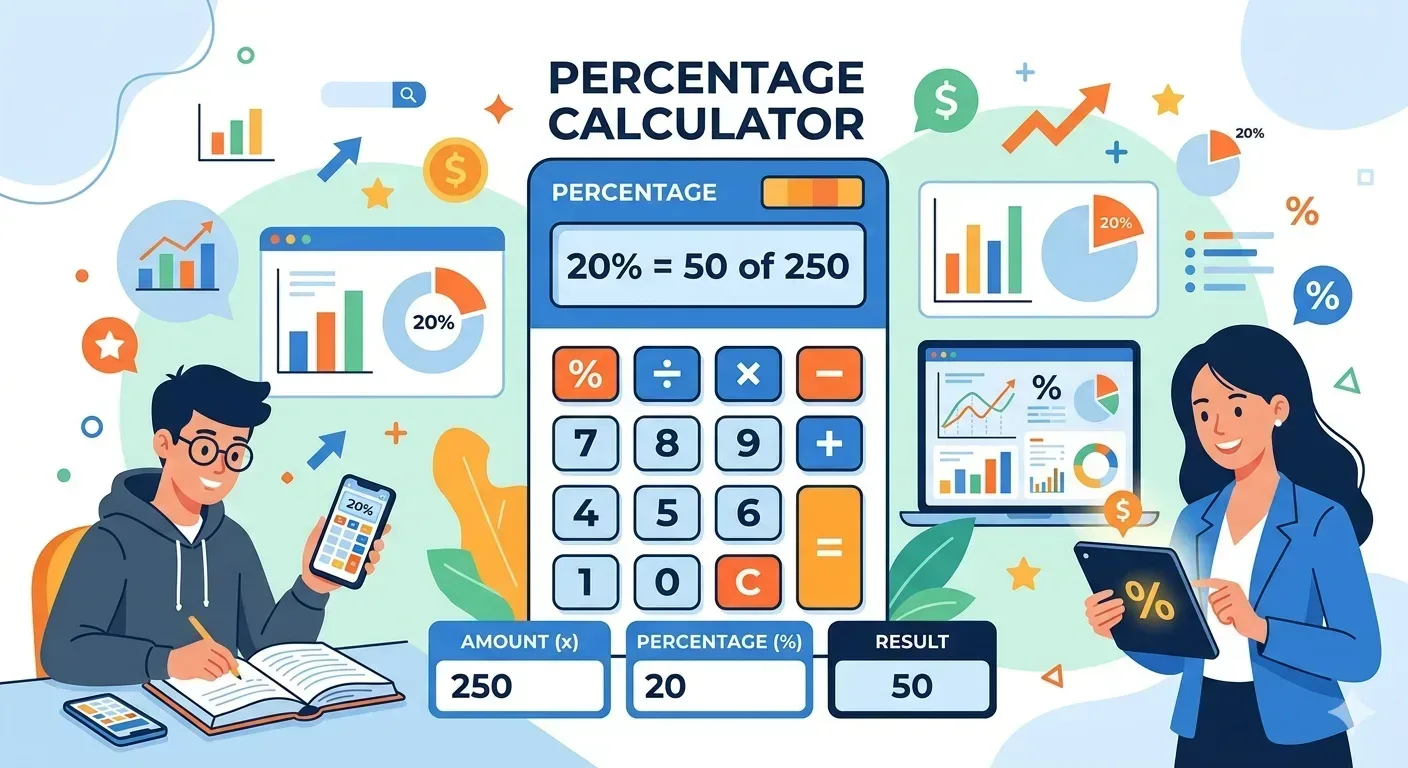
Even with a percentage calculator in hand it is possible to get the wrong answer if you are not careful about how you set up the problem. These are the most frequent mistakes and how to avoid each one.Confusing the part and the whole. In the formula for finding what percent a part is of a whole you divide the part by the whole and not the other way around. Reversing these two numbers gives you an answer that can be wildly different from the correct one.
Forgetting to divide by the old value in percentage change calculations. Some people subtract the old value from the new one and stop there ending up with the raw difference rather than the percentage change.
Applying percentage discounts incorrectly. Many people subtract the percentage number directly from the price rather than calculating that percentage of the price and then subtracting.
Adding stacked discounts together. A 20 percent discount followed by a 15 percent discount does not equal a 35 percent total discount. Each successive discount applies to a smaller base making the real total closer to 32 percent.
Conclusion
Percentages show up in almost every corner of modern life. From the moment you check how much battery your phone has left to the moment you review your investment returns before bed you are interacting with percentage based information constantly. Having a percentage calculator readily available means you are always one quick calculation away from a clear answer.
The beauty of a percentage calculator is not just speed. It is the elimination of uncertainty. When you calculate a percentage mentally there is always a small chance you made an arithmetic slip. When you use a reliable percentage calculator you know the number is right. That confidence allows you to make decisions faster and with greater assurance.
For students a percentage calculator is a learning tool as much as a shortcut. For professionals it is a time saving instrument that keeps their analysis sharp and their reports accurate. For everyday consumers it is a tool that helps them evaluate deals compare prices and understand the financial information that businesses and governments present to them every day.
Learning to use a percentage calculator well is one of those small investments that pays back in clarity for the rest of your life. The formulas behind it are simple the applications are nearly endless and the value it adds to your daily decision making is genuinely hard to overstate.
A percentage calculator is a mathematical tool that computes how one number relates to another as a portion out of one hundred. It handles three fundamental types of calculations: finding a percentage of a given number, finding what percentage one number is of another number, and calculating the percentage change between two values. More specialized versions handle discounts tip amounts tax rates and grade averages.
To find a percentage of a number manually you convert the percentage into a decimal by dividing it by one hundred and then multiply that decimal by the number in question. For example to find 25 percent of 80 you convert 25 percent to 0.25 and multiply by 80 which gives you 20. A helpful shortcut for finding ten percent of any number is to simply move the decimal point one place to the left.
A percentage expresses how large one quantity is relative to another as a fraction of one hundred. A percentile on the other hand tells you where a specific score falls within a distribution of values. If you scored in the 90th percentile on a test it means you scored higher than 90 percent of all test takers. Percentage describes a ratio while percentile describes a rank within a group.
Yes absolutely. When expressing a part as a proportion of a whole the percentage maxes out at one hundred. But percentage change calculations can easily exceed one hundred percent. If something doubles in value it has increased by one hundred percent. If it triples it has increased by two hundred percent. Retail markup percentages frequently exceed one hundred percent as well.
Yes, many free percentage calculator apps are available on Android and iOS. These include general-purpose percentage calculator apps as well as specialized ones like the IGNOU percentage calculator app, the attendance percentage calculator, and the marks percentage calculator. A percentage calculator APK can also be downloaded and installed directly on Android devices. Most apps work offline and provide instant results.
If you increase a number by 20 percent and then decrease the result by 20 percent you do not end up back at the original number. The reason is that the two calculations use different base values. The second decrease applies to a larger base so 20 percent of that larger number is a bigger absolute amount. A 20 percent increase followed by a 20 percent decrease leaves you at 96 percent of where you started.
When calculating how much tax you owe on an income or purchase you multiply the taxable amount by the tax rate expressed as a decimal. A ten percent sales tax on a 400 dollar purchase equals 40 dollars in tax making the total 440 dollars. Some percentage calculators also work in reverse letting you extract the pre-tax price from a tax-inclusive total.
Ten percent of any number is found instantly by shifting the decimal one place to the left. Five percent is half of that. Twenty percent is double the ten percent amount. Fifty percent is half the total. For less round percentages you can combine these anchors. To find 35 percent mentally you calculate 30 percent and then add five percent to it.
To calculate a tip you enter the total bill amount and multiply it by the tip percentage you want to leave. A 20 percent tip on an 85 dollar meal would be 17 dollars. For fast mental estimation remember that 10 percent of the bill doubled gives you 20 percent. Many online percentage calculators have a dedicated tip calculator mode that handles the entire calculation in one step.
A percentage calculator is highly accurate for basic financial planning tasks such as calculating savings rates comparing price changes working out loan interest amounts and measuring investment returns. For complex situations involving compound interest over long periods or tax implications across multiple years it is best to use a calculator specifically built for that purpose or to consult a qualified financial advisor.